


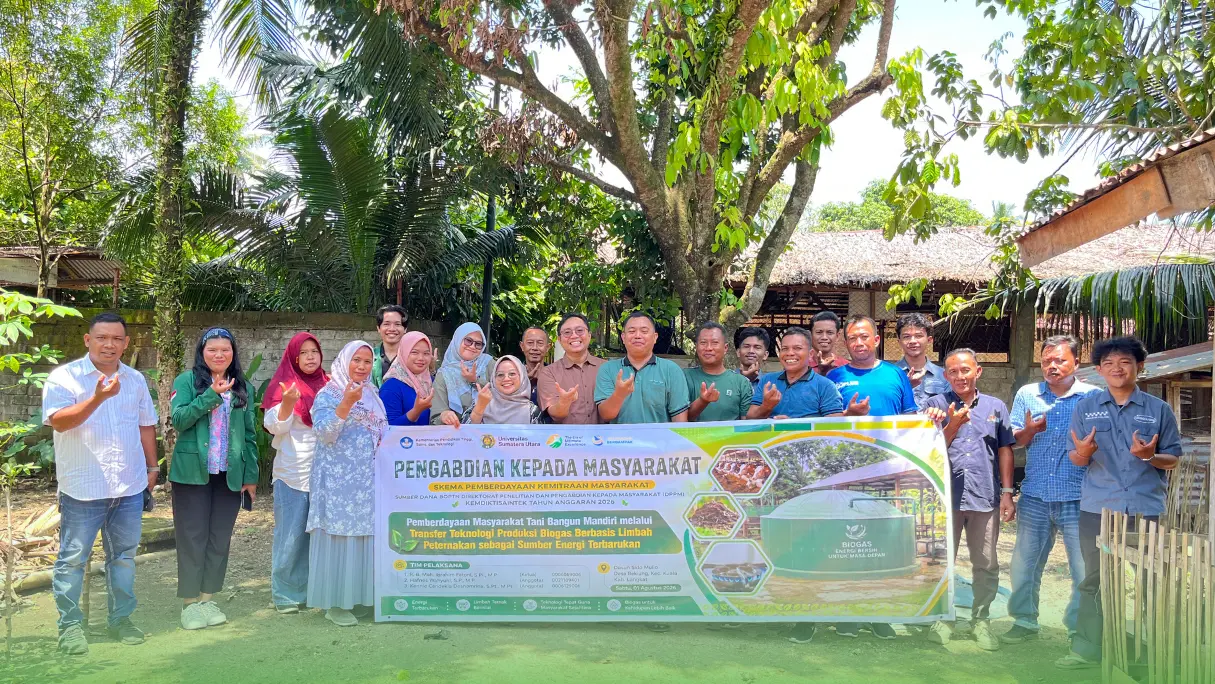
MEDAN — The Agribusiness Study Program, in collaboration with the Agrotechnology and Animal Science Study Programs of the Faculty of Agriculture, Universitas Sumatera Utara (USU), has once again implemented a community empowerment program addressing environmental and energy challenges in rural areas. Under the theme “Empowering Bangun Mandiri Farming Communities through Technology Transfer for Livestock-Waste-Based Biogas Production as a Renewable Energy Source,” the program was conducted in Bekiung Village, Kuala District, Langkat Regency, on Saturday, August 1, 2026.
The activity was attended by the Deputy Head of Bekiung Village, the Chairperson of the Livestock Farmers’ Group, and the Chairperson of BUMDes Bangun Mandiri, demonstrating strong support from the village government and local community institutions.
Livestock Waste That Has Long Been Left Unmanaged
Bekiung Village is predominantly inhabited by farmers and livestock breeders. Nearly every household raises cattle, with each farmer keeping between two and ten animals. However, cattle manure has traditionally been managed using conventional methods, resulting in environmental problems such as unpleasant odors and muddy livestock pens, particularly during the rainy season.
At the same time, the increasing cost and inconsistent availability of liquefied petroleum gas (LPG) have presented additional challenges for local households in meeting their energy needs.
A Solution: Household-Scale Biogas
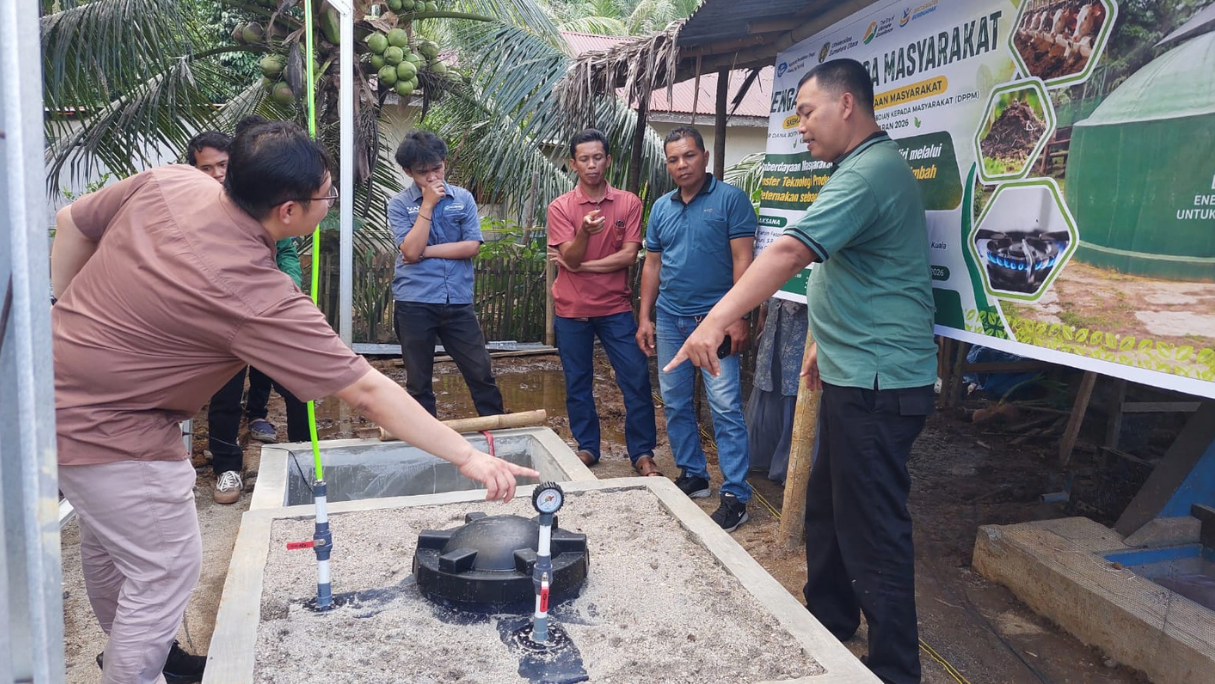
To address both challenges simultaneously, the community engagement team introduced household- and farmer-group-scale biogas technology. Cattle manure is processed through anaerobic fermentation to produce biogas that can be used directly as cooking fuel, reducing households’ dependence on LPG. The resulting by-product, known as slurry, can be utilized as organic fertilizer to improve agricultural soil fertility.
The program included socialization sessions, training and hands-on field practice, construction of biogas installations, as well as ongoing assistance and joint evaluation with community partners. These activities are intended to ensure that the technology can be managed independently and sustainably by the local community.
Welcomed Enthusiastically by Village Officials
The Community Engagement Team, led by R. B. Moh. Ibrahim Fatoni, S.Pi., M.P., with members Hafnes Wahyuni, S.P., M.P., and Kennie Cendekia Desnamrina, S.Pt., M.Pt., explained that the program focuses not only on technical aspects but also on strengthening farmer-group institutions.
“We want the community not only to be able to produce biogas, but also to manage and maintain the system independently after the program ends,” he said.
The Deputy Head of Bekiung Village welcomed the initiative and expressed hope that the biogas technology could be replicated in more households. The Chairperson of BUMDes Bangun Mandiri also noted that the program is aligned with the long-term development plan for an Educational Tourism Village (Desa Eduwisata) in Sido Mulio Hamlet. Meanwhile, the Chairperson of the Livestock Farmers’ Group stated that the availability of biogas would significantly support households’ energy needs.
The activity also involved five FP USU students as part of the Kampus Berdampak recognition program, providing them with practical experience in applying their academic knowledge directly within the community.
This Community Engagement Program represents a concrete contribution by higher education institutions to several Sustainable Development Goals (SDGs), including SDG 7: Affordable and Clean Energy, through the provision of environmentally friendly biogas as a renewable energy source for farming households; SDG 8: Decent Work and Economic Growth, through reductions in household energy costs and increased efficiency in agricultural activities; and SDG 12: Responsible Consumption and Production, through sustainable livestock-waste management and the utilization of slurry as organic fertilizer.
The Community Engagement Program was funded by the Directorate of Management and Quality Improvement of Research and Community Engagement (DPPM), Ministry of Higher Education, Science, and Technology (Kemdikbudristek), Fiscal Year 2026.
Moving forward, the community engagement team hopes that the biogas technology can be further developed and independently replicated by the residents of Bekiung Village, while contributing to the development of an energy-independent, environmentally friendly, and prosperous village.