


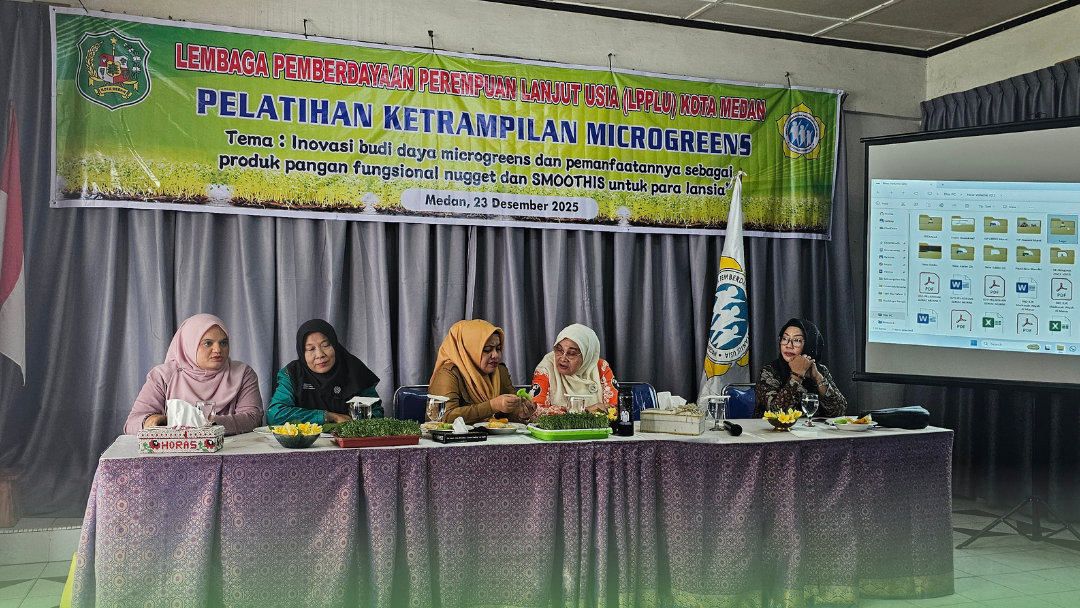
Medan, December 23, 2025 — The Faculty of Agriculture, Universitas Sumatera Utara (FP USU), once again demonstrated its commitment to supporting community empowerment through educational activities and training based on agricultural innovation. Vira Irma Sari, S.P., M.Si., a lecturer from the Agrotechnology Study Program, Faculty of Agriculture, Universitas Sumatera Utara, served as a speaker in the “Microgreens Skills Training” with the theme “Microgreens Cultivation Innovation and Its Utilization as Functional Food Products: Nuggets and Smoothies for Seniors.”
The activity was organized by the Medan Institute for the Empowerment of Elderly Women (LPPLU) of Medan City, an institution under the auspices of the Office of Women’s Empowerment, Child Protection, Community Empowerment, Population Control, and Family Planning (DP3APM-P2KB).
The training was one of the efforts to improve participants’ knowledge and skills, particularly among senior citizens, in utilizing simple spaces and resources to produce healthy food through microgreens cultivation. In addition to being easy to cultivate, microgreens also have the potential to be developed into various innovative and nutritious food products.
During the presentation session, Vira Irma Sari, S.P., M.Si., explained the basic concepts of microgreens, including their definition, benefits, cultivation techniques, seed and growing-medium selection, and harvesting processes. Participants also gained an understanding of the potential of microgreens as a nutritious food source that can be easily cultivated in a household environment.
The activity then continued with hands-on training in microgreens cultivation or planting. Through the practical session, participants directly learned the stages of planting microgreens, enabling them to apply these skills independently at home.
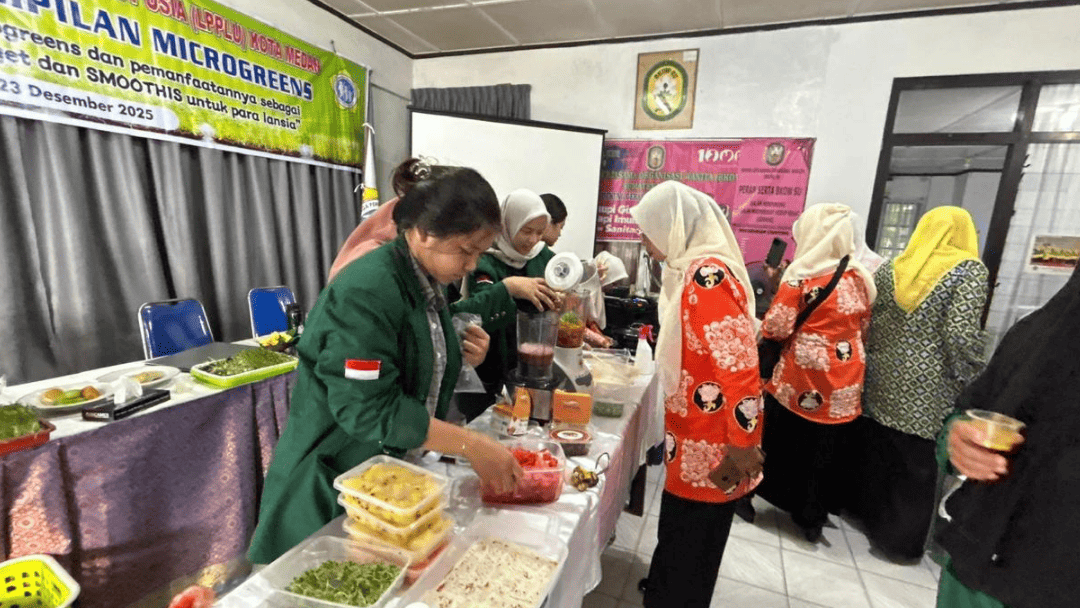
The training not only focused on cultivation but also provided participants with hands-on experience in processing microgreens into functional food products. One of the products introduced was microgreens smoothies combined with various fruits. Several smoothie variations prepared during the training included mango–papaya, banana–pineapple, watermelon–mint leaves, and banana–dates, combined with mustard green microgreens, coconut water, and honey.
These combinations produced beverages that were not only fresh and appealing in taste but also served as an alternative for increasing the consumption of nutritious food ingredients. Processing microgreens into smoothies is also expected to provide an easier and more enjoyable way to consume vegetables, particularly for groups who are less inclined to consume vegetables directly.
In addition to smoothies, participants also received training in making microgreens nuggets. Nuggets were selected as a form of food innovation because they are familiar and popular among various age groups, from children to seniors. Adding microgreens to nuggets is one strategy to increase the nutritional value of the product without eliminating the characteristics of a familiar food.
Thus, consumers can enjoy nuggets as they normally would while simultaneously obtaining additional nutrients from microgreens, which are highly nutritious food ingredients. This innovation demonstrates that developing healthy food does not always require drastic changes in consumption patterns, but can also be achieved by improving the nutritional value of food products that are already familiar in everyday life.
According to Vira Irma Sari, microgreens have significant potential for household-scale cultivation because the cultivation process is relatively simple, requires limited space, and has a short harvesting period. Therefore, skills in cultivating and processing microgreens can serve as an alternative productive activity while supporting the availability of healthy food for families.
This activity also has strong connections with the achievement of the Sustainable Development Goals (SDGs). First, it supports SDG 2: Zero Hunger by increasing public access to and knowledge of nutritious food sources that can be independently produced at home.
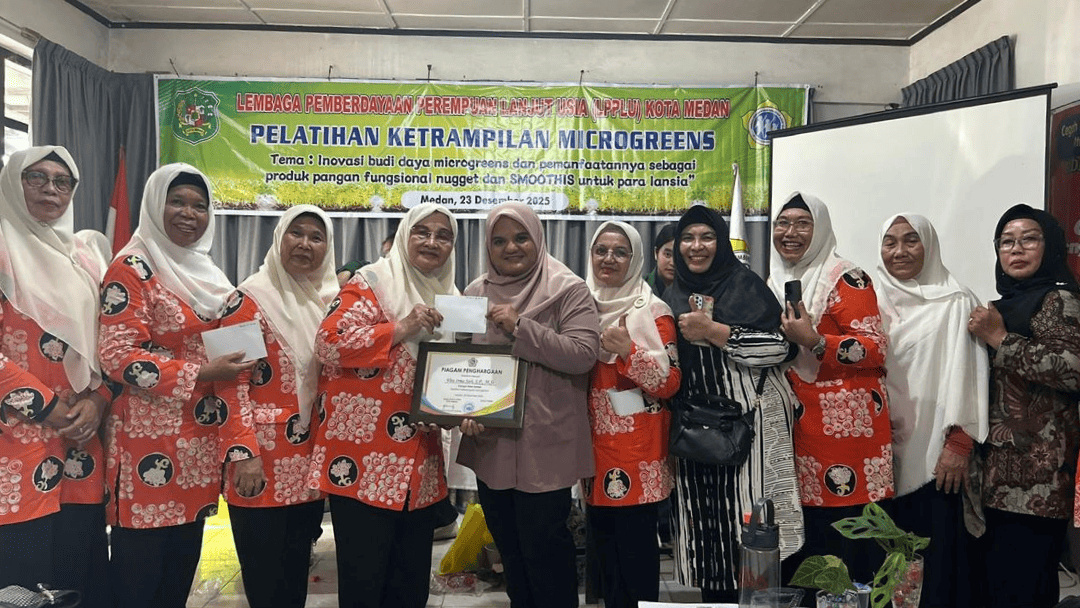
Furthermore, the training aligns with SDG 3: Good Health and Well-Being by introducing microgreens as part of a healthier and more diverse food consumption pattern. Processing microgreens into smoothies and nuggets also represents an innovation to support nutritious food consumption among various age groups, including seniors.
The community empowerment activity also supports SDG 5: Gender Equality by strengthening women’s capacities and skills, as well as SDG 10: Reduced Inequalities by providing senior citizens with opportunities to remain active and productive while gaining access to new knowledge and skills.
Moreover, utilizing limited spaces to independently produce food also contributes to SDG 11: Sustainable Cities and Communities. Meanwhile, the innovation of processing microgreens into value-added food products aligns with the spirit of SDG 12: Responsible Consumption and Production.
Through this activity, the Faculty of Agriculture, Universitas Sumatera Utara, not only plays a role in the development of knowledge and education but also actively transforms academic knowledge into practical skills that can provide direct benefits to the community.
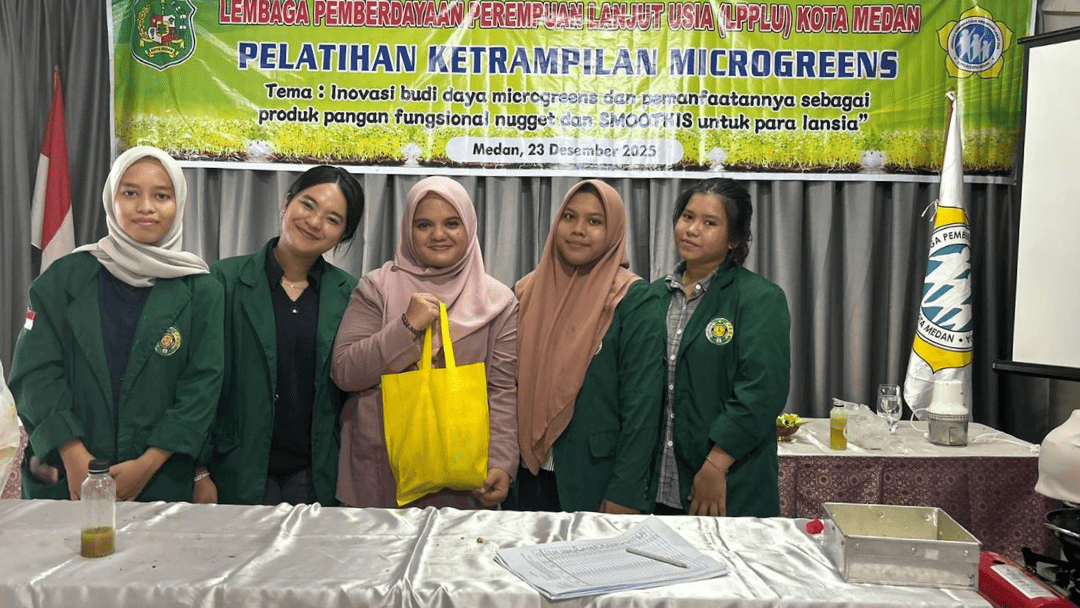
The collaboration between the Faculty of Agriculture, Universitas Sumatera Utara, and LPPLU Medan City is expected to continue expanding through various community empowerment programs based on agriculture, food, and health. Going forward, microgreens have the potential to become a simple agricultural innovation that supports household food self-reliance while creating opportunities for the development of healthy and economically valuable food products.
The Microgreens Skills Training demonstrated that agricultural innovation can be incorporated into everyday life—from planting to processing—and can serve as a means of building a healthier, more productive, and empowered community.