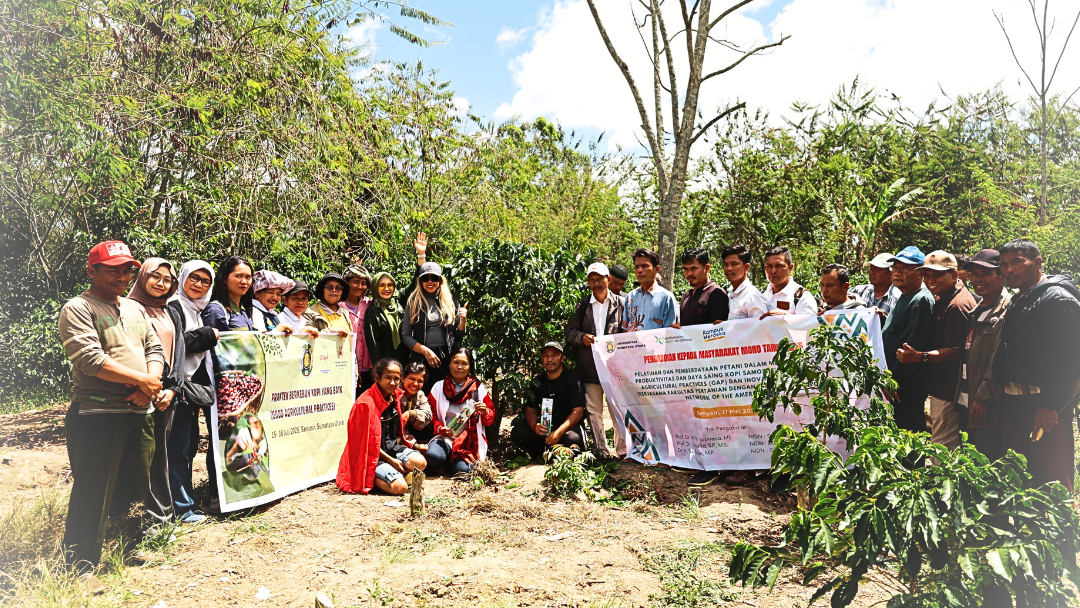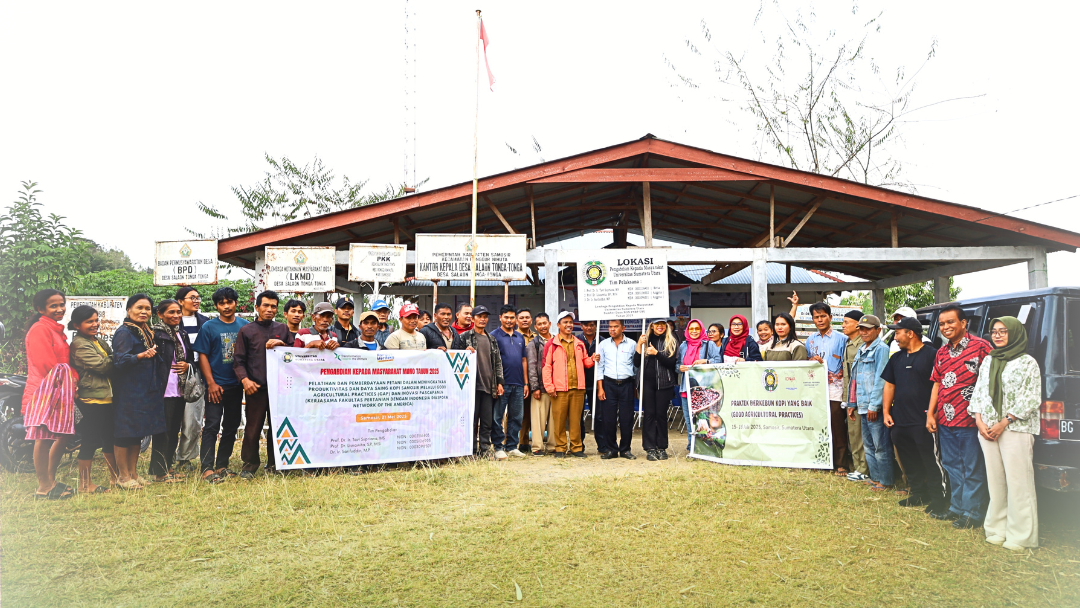
Medan – Public Relations of the Faculty of Agriculture USU: The Faculty of Agriculture, Universitas Sumatera Utara (USU), in collaboration with the Indonesia Diaspora Network of The America (IDN of America), organized a Community Service Program (Mono Year 2025) in the form of Training and Empowerment of Farmers to Increase the Productivity and Competitiveness of Samosir Coffee through Good Agricultural Practices (GAP) and Post-Harvest Innovation. The event took place on July 15–16, 2025, in Salaon Tonga-tonga Village, Ronggurnihuta District, Samosir Regency, North Sumatra.
The event was attended by Samosir coffee farmers, the Samosir Coffee IKM Production Cooperative, representatives from the Samosir Food Security and Agriculture Office, a team from the Faculty of Agriculture USU, and the Executive Director of IDN of America who also serves as the Chair of the Samosir Coffee IKM Center, Velisia Sitanggang Sexton.
The USU team was led by Prof. Dr. Ir. Tavi Supriana, MS, with members Prof. Dr. Lisnawita, S.P., M.Si., and Dr. Ir. Sarifuddin, M.P. They invited expert speakers, including Ir. Syahnen Pane and Sugono, S.P, to provide direct technical training to the farmers.
Key training materials included:
Pest and disease control for coffee plants by Prof. Dr. Lisnawita, S.P., M.Si.
Soil nutrient and pH analysis and the use of Dry Soil Test Kits (PUTK) by Dr. Ir. Sarifuddin, M.P.
Organic composting techniques using agricultural waste by Ir. Syahnen Pane
Coffee pruning techniques to enhance productivity by Sugono, S.P.
Participants also practiced pruning, pest control, and PUTK device usage in the field to determine soil fertility and acidity, which serve as the basis for site-specific fertilization recommendations..png)
The Samosir Food Security and Agriculture Office welcomed the initiative, stating that they had previously supported farmer groups in Salaon Tonga-tonga, including encouraging composting using corn husks and rice straw. However, due to limited funding, not all farmer groups could be facilitated, especially in terms of coffee tree rejuvenation.
Prof. Tavi Supriana expressed that the program stemmed from concern over the untapped potential of Samosir coffee. “The U.S. market is huge for Indonesian coffee, especially from Sumatra. But the supply is limited. That’s why we are here — to support farmers in enhancing the quality and productivity of their coffee,” she said.
IDN of America’s Executive Director, Velisia Sitanggang Sexton, conveyed her appreciation for the experts’ hands-on involvement. “I’m truly impressed. It’s amazing that the experts are directly present in the field. We are optimistic that the quality of Samosir coffee will continue to improve and gain recognition in global markets,” said Mrs. Velisia.
Farmer representative Sihar Simbolon also expressed gratitude to USU. “We’re very thankful for the knowledge shared. We hope this program continues and that we can apply what we’ve learned to improve our coffee quality. Horas!” he concluded.
This activity is expected to serve as the beginning of a sustainable collaboration between academics, the diaspora, and local farmers to establish Samosir coffee as a high-value commodity in international markets.