


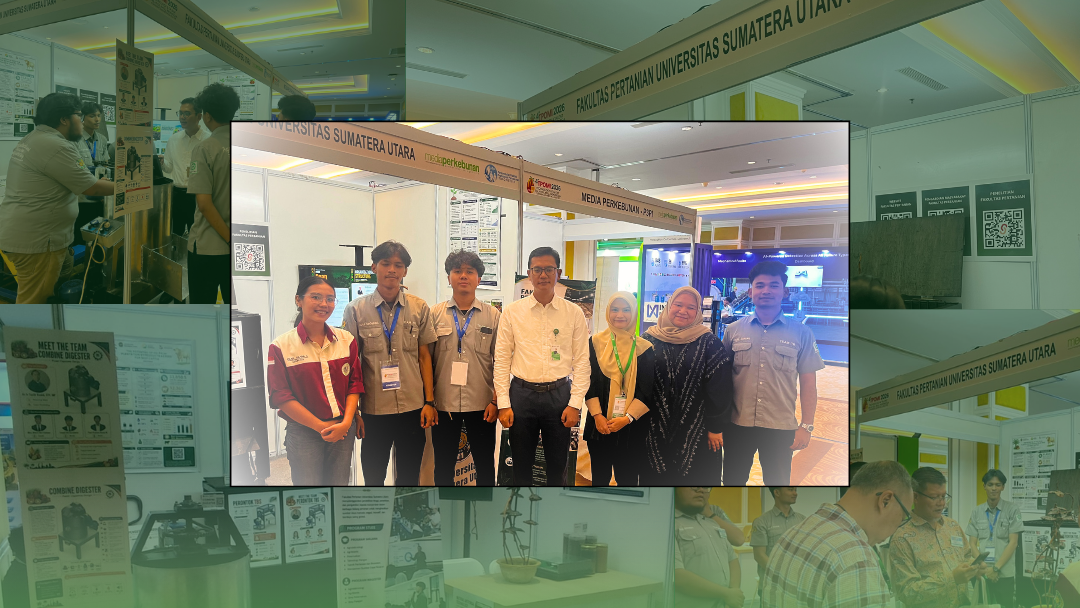
Medan, July 10, 2026 – The Faculty of Agriculture, Universitas Sumatera Utara (USU) participated in the 4th Technology and Talent Palm Oil Mill Indonesia (T-POMI) 2026, held from July 8–10, 2026, at Adimulia Hotel Medan. The event provided a strategic platform for the Faculty to promote its research achievements, technological innovations, scientific publications, and academic programs while strengthening partnerships with government agencies, industry, research institutions, and international collaborators.
Throughout the exhibition, the Faculty's booth featured a wide range of research products, technological innovations, books authored by faculty members, scientific posters, and information about its academic programs. One of the highlights that attracted significant attention was the Combine Digester, an innovation developed by students of the program in Agricultural and Biosystems Engineering, which demonstrates strong potential to improve processing efficiency within the palm oil industry.
The innovation reflects the Faculty of Agriculture's commitment to research-based education that encourages the development of practical solutions for societal and industrial challenges. This initiative aligns with SDG 4 (Quality Education) by enhancing innovation-driven higher education and SDG 9 (Industry, Innovation and Infrastructure) through the development of technologies that support the advancement of the agro-industrial sector.
During the exhibition, the Faculty's booth welcomed representatives from the North Sumatra Center for Animal, Fish, and Plant Quarantine (BBKHIT), the Indonesian Oil Palm Research Institute (PPKS), and delegates from institutions in the Philippines. Visitors expressed appreciation for the research and innovations on display and showed interest in establishing future collaborations in research and technological development.
On the second day of the event, discussions with conference participants generated valuable recommendations for improving the Combine Digester, particularly regarding its design, processing capacity, and operational efficiency to enhance its readiness for industrial-scale application. These insights will serve as important input for the continued refinement of the technology to better meet industry needs.
Although visitor numbers declined on the third day as many conference participants joined scheduled field trips, the Faculty of Agriculture's booth remained an important information center for alumni, students, and visitors interested in learning more about the Faculty's research achievements and academic offerings.
Overall, the Faculty of Agriculture's participation in the 4th T-POMI 2026 successfully strengthened the dissemination of research outcomes, increased the visibility of its technological innovations, and created new opportunities for collaboration with a wide range of stakeholders. The partnerships established during the event support SDG 17 (Partnerships for the Goals) by fostering collaboration among universities, government agencies, research institutions, and industry, while also contributing to SDG 8 (Decent Work and Economic Growth) through the development of innovations that enhance the competitiveness and sustainability of the agro-industrial sector.