


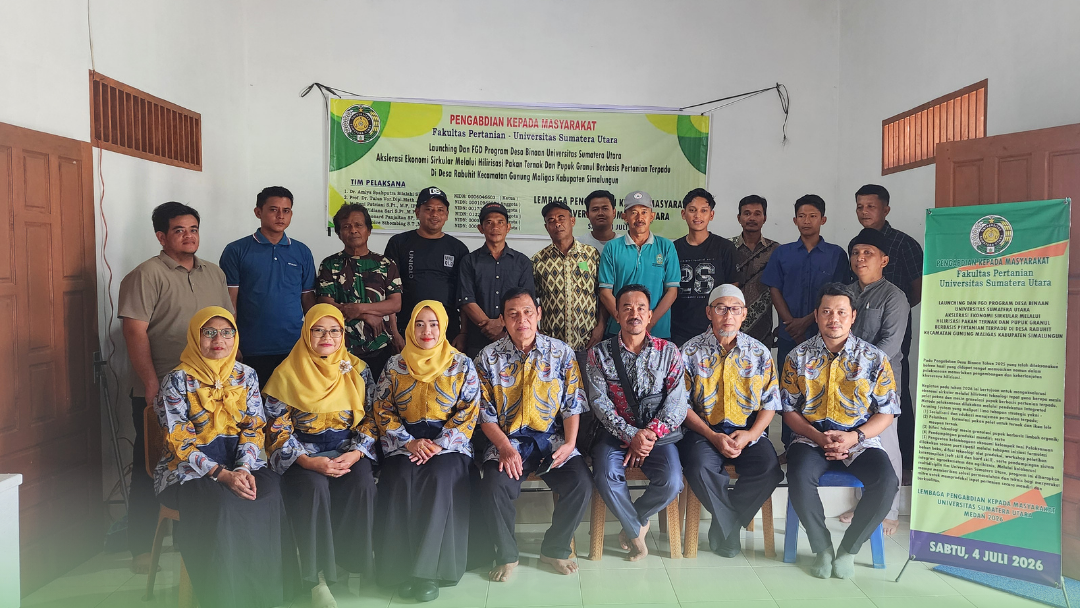
A community service team from Universitas Sumatera Utara (USU) has officially launched the Assisted Village Program in Rabuhit Village, Gunung Maligas District, Simalungun Regency. The strategic initiative aims to address the high costs of agricultural and livestock production that have long burdened the local community.
The launch marks the beginning of a technology-based initiative to transform agricultural and livestock waste into animal feed and granular organic fertilizer. The program's lead proposer, Dr. Amlys Syahputra Silalahi, S.E., M.Si., explained that the initiative was designed to address two major challenges faced by Rabuhit Village: dependence on expensive commercial feed and chemical fertilizers, and environmental degradation caused by the accumulation of livestock manure and crop residues.
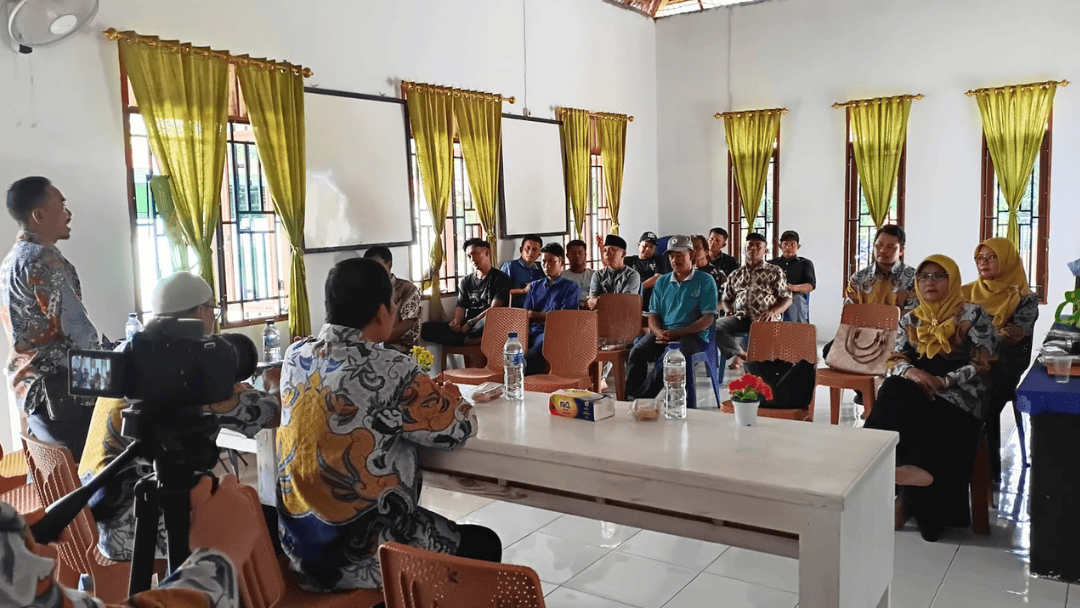
The program was warmly welcomed by the village government, local farmer-livestock groups, and the Head of Rabuhit Village, Rohiman. As part of the initiative, community members will receive direct mentoring through both technical (hard skills) and non-technical (soft skills) training. Field implementation includes the provision of a pelletizer machine for producing fish and poultry feed, as well as a granulator machine to process cattle and goat manure into market-ready organic fertilizer.
Supported by the USU Institute for Research and Community Service (LPPM), the multidisciplinary team includes Prof. Dr. Tulus from the Faculty of Mathematics and Natural Sciences; Ir. Peni Patriani, S.Pt., M.P., IPM., ASEAN Eng.; Ir. Tati Vidiana Sari, S.Pt., M.P., IPM.; and Helova Leonard Panjaitan, S.P., M.P. from the Faculty of Agriculture; as well as Hendrik Voice Sihombing, S.T., M.T. from the Faculty of Engineering. Scheduled to run through November 2026, the program is expected to establish a zero-waste ecosystem in Rabuhit Village while improving the welfare and economic resilience of local farmers and livestock breeders.
The Assisted Village Program aligns with the United Nations Sustainable Development Goals (SDGs), particularly SDG 3 (Good Health and Well-being) and SDG 8 (Decent Work and Economic Growth). By converting livestock waste into organic fertilizer, the initiative helps mitigate environmental pollution and promotes healthier living conditions within the village. Meanwhile, the transfer of technology through pelletizer and granulator machines is expected to reduce operational costs, create opportunities for community-based enterprises, and strengthen the long-term economic independence and prosperity of the people of Rabuhit Village.