


Medan-USU: Several factors render a research paper less beneficial, including: 1. Research papers published still in the Indonesian language, 2. Limited publication only in the Indonesian region, or even just locally. According to the regulations of the Ministry of Research, Technology, and Higher Education (Kemenristekdikti), a paper originating from a seminar, symposium, or conference will be considered nationally scaled if the committee/panel is from five universities in Indonesia. For the international scale, the committee must consist of five universities, with four from outside Indonesia and one from Indonesia. This was conveyed by Vice Rector III of the Universitas Sumatera Utara (USU), Drs. Mahyuddin, M.I.T., Ph.D., when officially opening the Socialization Event on Publication Obligations for Postgraduate Students at USU on June 4, 2016, in the Senate Meeting Room, BPA Building, USU.
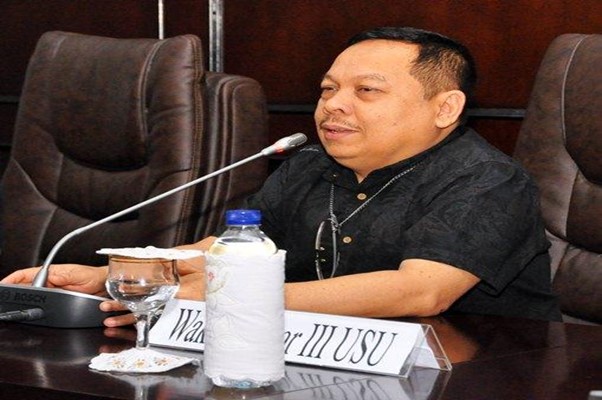
Drs. Mahyuddin, M.I.T., Ph.D., Vice Rector III of USU, stated that every postgraduate student completing their education must have innovation, whether it is of the Discovery or Intention type. Discovery is something that already exists but is not yet known in depth. Meanwhile, Intention is something new discovered through the student's research. Research in the form of Discovery is usually carried out by master's students, while Intentional research is done by doctoral students.
Vice Rector III of USU, Drs. Mahyuddin, M.I.T., Ph.D., emphasized that one crucial aspect of research is that the researcher/author must be able to claim that the research is genuinely the result of their own thoughts/ideas and not plagiarism. Proving the authenticity of the research is done by publishing it. "We are here to provide guidance/socialization to postgraduate students at the Universitas Sumatera Utara on the importance of research publication," he expressed.
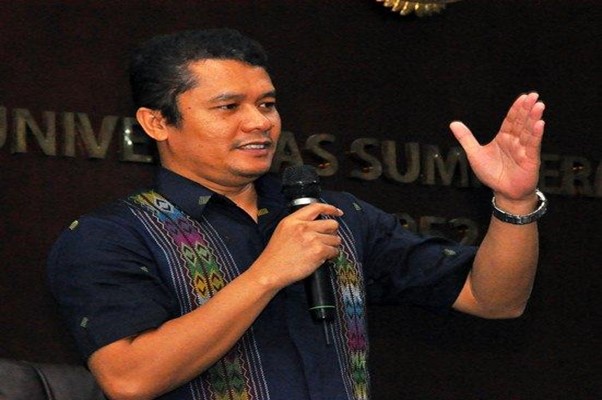
The speaker at the event was Dr. Himsar Ambarita, S.T., M.T., from the Faculty of Engineering at USU, who currently holds the position of a reviewer for international-scale research and also serves as the head of the USU Scientific Publication Commission (KPI). In his presentation, Dr. Himsar Ambarita encouraged postgraduate students at USU to be more active in conducting research. "What's the point of holding high degrees if we don't contribute to the development of our society?" Dr. Himsar began his presentation to approximately 500 participants at the socialization event.
He explained that to be listed in the world of scientific publication, students need to undergo a training called 'Proceedings.' "Proceedings are a kind of training that is not just a regular scientific publication exercise because, with these proceedings, our names (as researchers) can shine internationally," Dr. Himsar expressed. Looking at the data presented, the productivity of USU's Scopus-indexed scientific publications in recent years has experienced a significant increase, exceeding 70 (on a scale of 0-80). However, the total number of USU's scientific publications from 1971 to 2016 is still below UNAND, and even far below ITB, whose scientific publication levels have reached 5000 (on a scale of 0–5000).
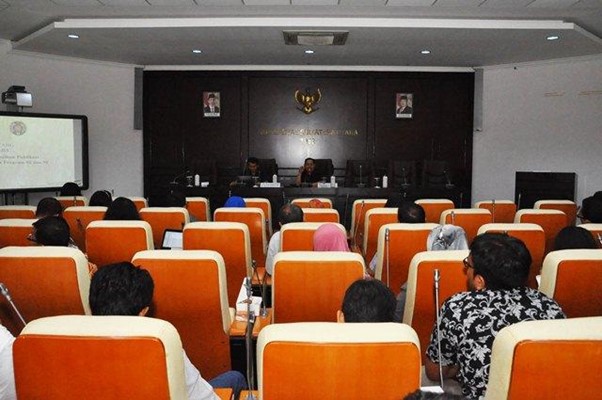
Based on the data presented, Dr. Himsar Ambarita provided several solutions to postgraduate students at the Universitas Sumatera Utara (USU) who were attending. These solutions include the obligation for lecturers to write and the encouragement or obligation for students to publish their works. Additionally, students are encouraged to participate in internationally indexed conferences. For example, in 2016, USU held several indexed conferences, including ICOSOP, focusing on the social sciences, PHICo for the health sector, and ICCAI, targeting informatics and engineering fields. (Public Relations/Andi).