


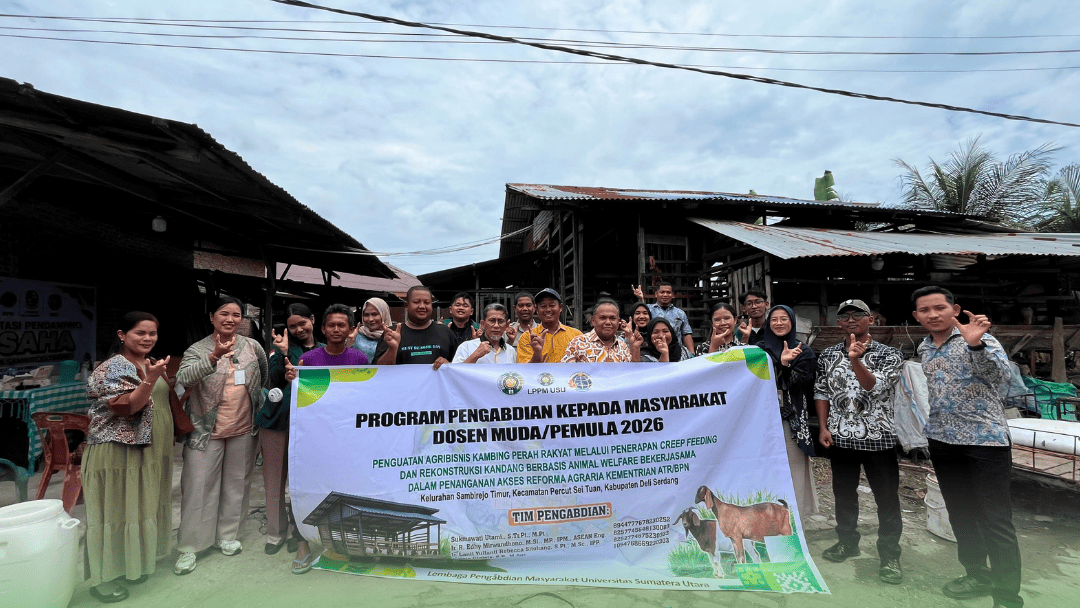
DELI SERDANG – Universitas Sumatera Utara (USU), through the Faculty of Agriculture, is strengthening the development of smallholder dairy goat farming in Sambirejo Timur Urban Village, Percut Sei Tuan District, Deli Serdang Regency, through the application of feed technology and improvements to housing systems based on animal welfare. The activity was carried out through collaboration between USU and ATR/BPN Deli Serdang Regency in support of the Community Land Empowerment Agrarian Reform Access Program.
The Community Service Program (PkM), entitled “Strengthening Smallholder Dairy Goat Agribusiness through the Application of Creep Feeding and Animal Welfare-Based Housing Reconstruction in Collaboration with the Handling of Agrarian Reform Access of the Ministry of ATR/BPN,” was held on Thursday, August 20, 2026, at Gang Domba, Peri Goat Barn, Sambirejo Timur Urban Village.
The activity involved approximately 40 participants consisting of members of the Sambirejo Timur Livestock Group, including members of the goat farmer group and grape farmer group. In addition to the Faculty of Agriculture USU lecturer team, the activity also involved four students from the Undergraduate Program in Animal Science at USU, the urban village government, agricultural extension officers of WKPP Sambirejo Timur, the Deli Serdang Regency Agriculture Office, ATR/BPN Deli Serdang Regency, PTPN 1 Regional, Community Service Program (KKN) students, and ASPAI (Indonesian Grape Farmers Association).
Addressing the Challenges of Smallholder Dairy Goat Farming
Sambirejo Timur Urban Village has significant potential for developing dairy goat farming as an agribusiness. However, farmers still face several challenges in its management, particularly in the management of does and kids, feed provision, and housing systems.
These conditions can affect the health, welfare, growth, and productivity of livestock. Therefore, the PkM activity was designed not only to transfer knowledge but also to improve farmers’ skills through the application of technology that can be implemented using resources available in the surrounding environment.
Through this activity, USU is encouraging the development of smallholder dairy goat farming beyond increasing livestock productivity toward a more efficient and sustainable agribusiness. These efforts are expected to increase the added value of livestock products while strengthening community welfare.
Farmers Practice Making Fermented Feed Directly
One of the focuses of the activity was improving feed quality and efficiency. Participants not only received information about feed technology but also took part in demonstrations and hands-on practice in preparing and mixing feed.
During the demonstration plot activity, farmers were introduced to the use of locally available raw materials, including corn ash, rice bran, cassava pulp, and other materials. The practice resulted in fermented feed made from locally sourced raw materials, which is expected to serve as a more accessible feed alternative for daily dairy goat management.
The hands-on approach was an important part of the activity. Farmers were able to observe and practice each stage of feed preparation directly, ensuring that the knowledge gained went beyond theoretical understanding.
The participants’ enthusiasm was evident in their active participation in the training, asking questions, engaging in discussions, and directly practicing the feed-making process. Participants also stated that hands-on practice helped them better understand how to prepare feed according to livestock needs and increased their motivation to independently apply the technology.
Promoting Safe and Comfortable Housing for Livestock
In addition to feed technology, the activity also paid attention to housing systems. Farmers were encouraged to begin implementing housing improvements that take into account the principles of animal welfare, including safety, comfort, cleanliness, and the natural needs of livestock.
These improvements are expected to support livestock health, kid growth, maintenance efficiency, and livestock farming productivity. Thus, quality feed and proper housing are positioned as two mutually supportive components in the development of smallholder dairy goat farming.
To support the sustainable application of the technology, the team also provided several supporting facilities, including a Techniku GX200 chopper machine, drums for feed silos, tarpaulins, and wooden materials. In addition, farmers received a practical guidebook on dairy goat farming as a reference for applying the knowledge gained after the activity.
Synergy between Higher Education and Government for Community Empowerment
This PkM activity was part of an effort to build synergy among higher education institutions, government, and communities through the Agrarian Reform Access Program. The collaboration was aimed at strengthening community capacity while opening opportunities for developing businesses based on local potential.
For USU, the activity also served as a learning opportunity for students. The involvement of students from the Undergraduate Program in Animal Science provided them with direct learning and community empowerment experience outside the campus environment. The activity is aligned with the achievement of the SDGs, particularly SDG 1 on No Poverty, SDG 8 on Decent Work and Economic Growth, and SDG 17 on Partnerships for the Goals.
The PkM team leader, Sukmawati Utami, S.Tr.Pt., M.Pt., together with team members Ir. R. Edhy Mirwandhono, M.Si., ASEAN.Eng., Ir. Lanti Yulianti Rebecca Sitohang, S.Pt., M.Sc., IPP., and Julieta Christy, S.P., M.Agr., encouraged the knowledge and technology provided to be continuously applied independently by the community. The team consists of lecturers from the Undergraduate Programs in Animal Science and Agrotechnology, Faculty of Agriculture USU.
Ir. R. Edhy Mirwandhono, M.Si., ASEAN.Eng. considers dairy goat farming to have significant potential for development, including under the concept of urban farming. According to him, the success of such a business is largely determined by feed quality and housing conditions that ensure the safety, comfort, and welfare of livestock.
“The right feed, comfortable housing, healthy goats, thriving business!”
The statement emphasizes that increasing dairy goat productivity needs to be carried out in an integrated manner, taking into account both feed quality and the livestock’s rearing environment.
Towards Sustainable Dairy Goat Agribusiness
The implementation of the activity in Sambirejo Timur marks an initial step toward transforming smallholder dairy goat farming into a more productive and sustainable agribusiness.
With increased farmer capacity in producing fermented feed from local materials and the initial implementation of animal welfare principles in livestock housing, the technology introduced is expected to continue being developed independently by livestock groups.
The synergy among USU, ATR/BPN Deli Serdang Regency, the local government, and the community is expected to continue beyond the training activities through further assistance and business development. Going forward, strengthening feed technology, livestock management, and housing systems is expected to increase the productivity, efficiency, added value, and welfare of dairy goat farmers in Sambirejo Timur.