


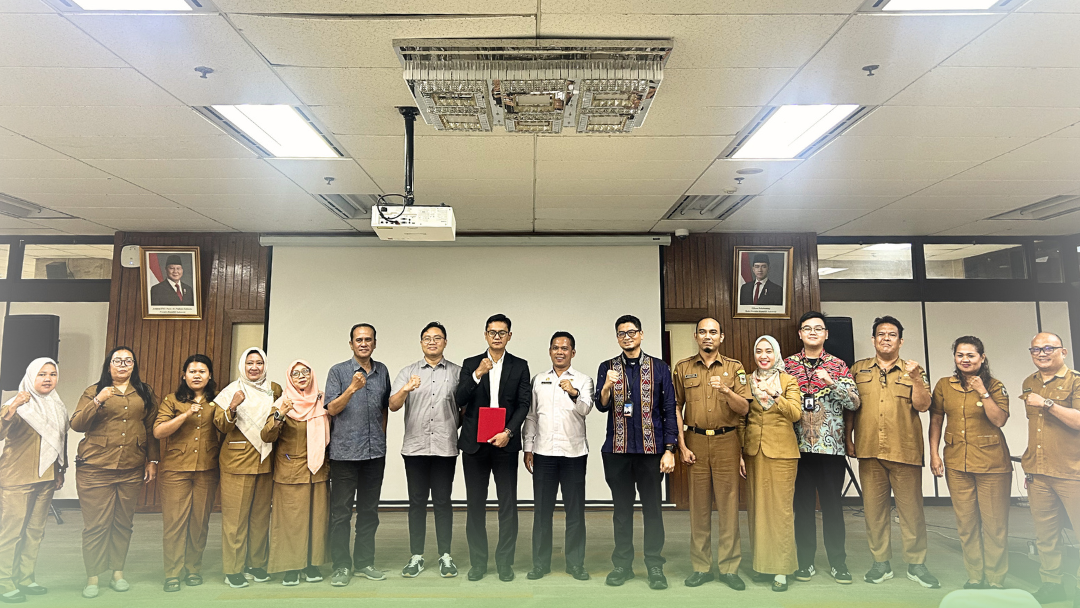
The Dean of the Faculty of Agriculture, Universitas Sumatera Utara (FP USU), Dr. Rulianda Purnomo Wibowo, S.P., M.Ec., participated as a keynote speaker in the Early Warning System (EWS) Focus Group Discussion (FGD) organized by the Pematangsiantar City Government in collaboration with Bank Indonesia's Pematangsiantar Representative Office on Tuesday, July 7, 2026, at the Bank Indonesia Building on H. Adam Malik Street, Pematangsiantar.
The discussion focused on formulating short- and medium-term action plans for developing an Early Warning System to support regional inflation control. During the session on food security and agriculture, Dr. Rulianda delivered a presentation entitled *"Commodity Price Early Warning System (CPEWS): A Tool for Food Security and Inflation Control in Indonesia."*
In his presentation, Dr. Rulianda explained that food commodity price stability is influenced not only by production and demand but also by climate change, stock availability, distribution conditions, logistics costs, exchange rate fluctuations, and international commodity prices. Given these complex dynamics, food inflation cannot be effectively managed through reactive measures alone but requires a system capable of identifying risks before they escalate.
To address this challenge, he introduced the Commodity Price Early Warning System (CPEWS), a decision-support system that integrates daily commodity prices, production data, planting and harvesting areas, food stocks, distribution networks, weather and climate information, exchange rates, international prices, and consumption patterns. These datasets are analyzed using econometric models, machine learning, Geographic Information System (GIS)-based spatial analysis, and a Dynamic Inflation Risk Index to generate price forecasts, early warning alerts, and policy recommendations.
Through this approach, governments can shift from reactive interventions to predictive and preventive policymaking. Rather than responding only after prices surge, policymakers can identify potential supply shortages, distribution disruptions, or demand spikes in advance and take appropriate action.
The system's ability to detect risks early also strengthens efforts to ensure both food availability and affordability, supporting **Sustainable Development Goal (SDG) 2: Zero Hunger** by helping ensure that communities, particularly vulnerable groups, have access to sufficient and nutritious food.
The CPEWS dashboard is designed to provide real-time information on commodity prices, production, food stocks, distribution conditions, and inflationary pressures. It also generates seven-day and thirty-day price forecasts, accompanied by risk indicators ranging from Normal, Alert, Warning, to Emergency. These analyses can guide market operations, strategic food reserve releases, distribution improvements, and production support measures.
Dr. Rulianda also emphasized the importance of integrated data systems and cross-sector collaboration. Successful implementation of CPEWS requires coordination among central and local governments, Bank Indonesia, the National Food Agency, BULOG, Statistics Indonesia (BPS), the Ministry of Agriculture, the Meteorology, Climatology, and Geophysics Agency (BMKG), and other relevant institutions. Such integration enables data that are currently dispersed across multiple agencies to be consolidated into a comprehensive evidence base for more effective policymaking.
This collaborative approach aligns with **SDG 17: Partnerships for the Goals**, recognizing that developing an effective food and inflation early warning system requires strong cooperation among government institutions, Bank Indonesia, universities, and data providers.
CPEWS also supports Indonesia's **4K Inflation Control Strategy**, which focuses on price affordability, supply availability, distribution efficiency, and effective communication. By identifying potential price increases before they become widespread, monitoring supply shortages, detecting logistical bottlenecks, and providing transparent information to policymakers and Regional Inflation Control Teams, the system enhances governments' capacity to respond proactively.
Furthermore, strengthening local governments' ability to anticipate food security and inflation risks contributes to **SDG 11: Sustainable Cities and Communities**. Resilient cities depend not only on physical infrastructure but also on their ability to secure essential goods, manage risks, and protect citizens' purchasing power during periods of economic pressure.
Looking ahead, the development of CPEWS is expected to evolve into a more intelligent early warning platform through the integration of artificial intelligence, machine learning, remote sensing, BMKG climate data, Internet of Things (IoT) technologies, and advanced spatial analytics. These innovations will enable the system to identify regions vulnerable to inflation and distribution disruptions while providing evidence-based policy recommendations for governments and Regional Inflation Control Teams.
Through its active participation in this initiative, the Faculty of Agriculture at Universitas Sumatera Utara reaffirms its commitment to strengthening food security and inflation management through science, technology, and data-driven innovation. Collaboration among universities, local governments, Bank Indonesia, and other stakeholders is expected to foster more anticipatory, adaptive, and impactful food policies that contribute to price stability and improve public welfare.