


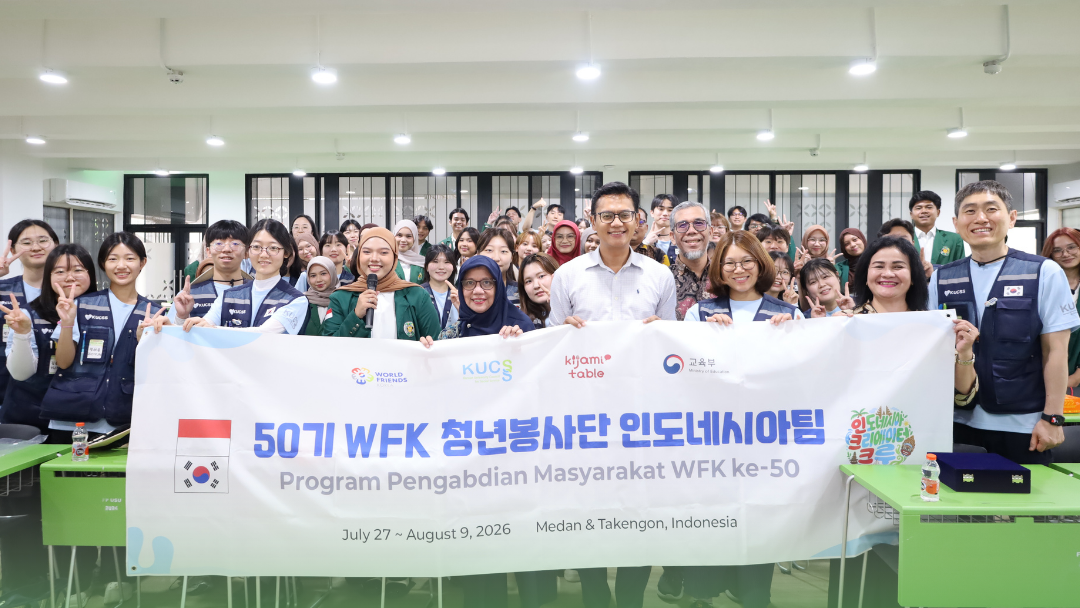
Medan, 28 July 2026 – The Faculty of Agriculture, Universitas Sumatera Utara (USU) held a public lecture entitled "Impacts and Risks of Climate Change on Indonesia's Agricultural Sector," delivered by the Dean of the Faculty of Agriculture, Dr. Rulianda Purnomo Wibowo, S.P., M.Ec., at Classroom I of the Faculty of Agriculture on Tuesday (28 July). The event formed part of the World Friends Korea (WFK) Youth Volunteer Program 2026, organized through a collaboration between the Faculty of Agriculture USU and Kajami's Table as a partner in facilitating international academic, cultural, and volunteer exchanges.
The event commenced with opening remarks from the Dean of the Faculty of Agriculture, who expressed his appreciation for the implementation of the international collaborative program. He emphasized that the initiative was not merely an academic visit but also a valuable opportunity for Indonesian and Korean students to exchange knowledge, experiences, and perspectives in addressing global challenges, particularly those related to agriculture and climate change.
"Today is not only about you coming here, but also a moment for everyone to share knowledge and perspectives. We have so much to learn from one another through our different experiences, cultures, and ideas. We hope this opportunity will strengthen our mutual understanding and help us build a better and more sustainable future together," said Dr. Rulianda.
The Chief Executive Officer of Kajami's Table, Sohee Eom, also expressed her appreciation for the warm welcome extended by the Faculty of Agriculture USU. She encouraged participants to make the most of the opportunity to broaden their horizons and gain meaningful experiences throughout the program in Indonesia.
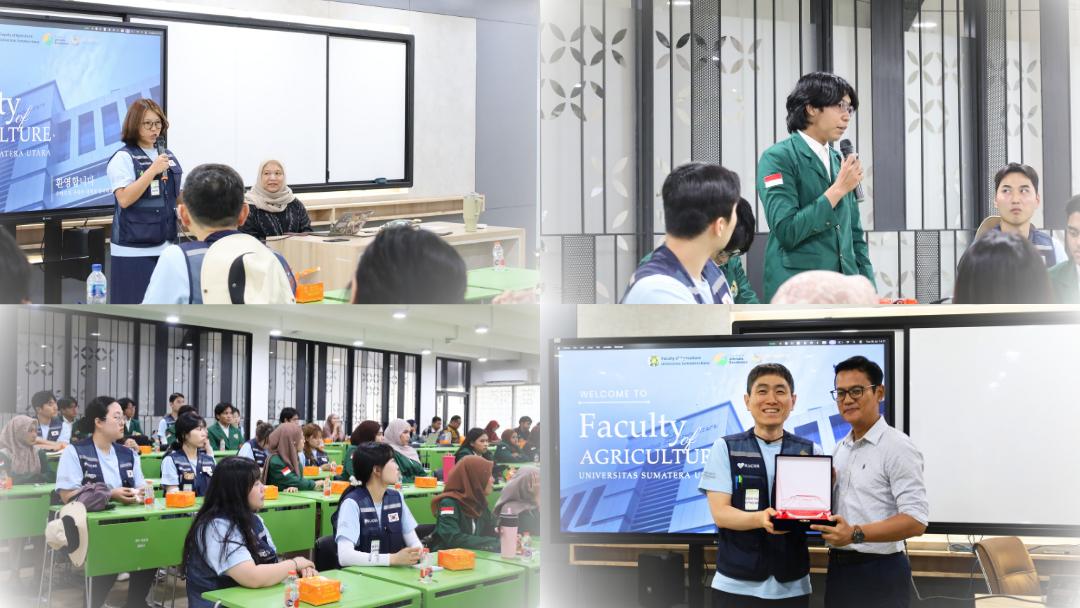
"There is so much to learn in Indonesia. From this experience, I hope you can gain new knowledge, broaden your perspectives, and build meaningful friendships that will continue beyond this program," said Sohee Eom.
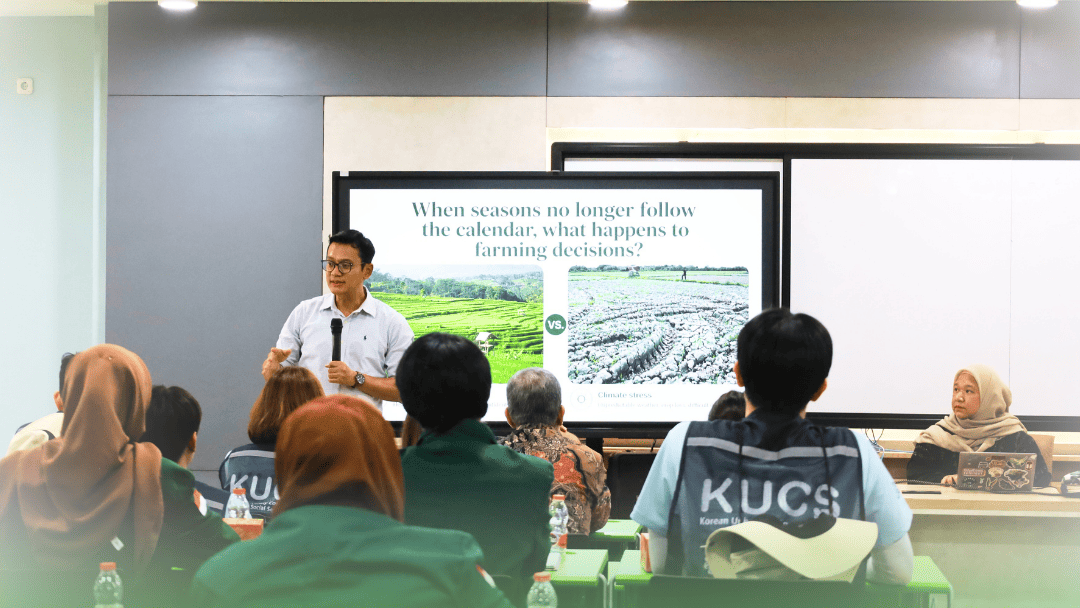
In his lecture, Dr. Rulianda explained that climate change has become one of the greatest challenges facing Indonesia's agricultural sector. Increasingly unpredictable seasonal patterns, along with more frequent floods, droughts, landslides, and extreme weather events, have created significant uncertainty for farmers in determining planting schedules while increasing the risk of crop failure.
He further emphasized that farmers' losses are driven not only by weather conditions but also by social, economic, and institutional vulnerabilities. When agricultural production is disrupted by climate change, the consequences extend throughout the food supply chain, affecting distribution systems, logistics costs, commodity prices, and ultimately public welfare. Therefore, climate change should be viewed not merely as an environmental issue but also as a critical challenge to economic development and food security.
During his presentation, Dr. Rulianda also outlined various strategies to strengthen the resilience of the agricultural sector through sustainable production systems, including the use of climate-informed cropping calendars, climate-resilient crop varieties, soil and water conservation, efficient irrigation, integrated pest management, crop diversification, and strengthening farmers' adaptive capacity through institutional support and public policy.
"Climate change does not only affect the environment, but also agricultural production systems, food supply chains, and farmers' livelihoods. Therefore, strengthening adaptive capacity and building resilient agricultural systems are essential to protect food security and ensure sustainable rural development," explained Dr. Rulianda.
He further stressed that the most effective approach to addressing climate change is to combine innovation at the farm level with strong institutional support, sound public policies, and collaboration among multiple stakeholders, enabling the agricultural sector to adapt while maintaining productivity amid increasingly complex climate challenges.
The public lecture concluded with an interactive discussion and question-and-answer session involving students from the Faculty of Agriculture, USU, and participants from various universities in South Korea. Topics discussed included climate change adaptation strategies, strengthening food security, and opportunities for future international collaboration.
Through this public lecture, the Faculty of Agriculture, Universitas Sumatera Utara, reaffirmed its commitment to advancing the internationalization of higher education while fostering a generation of young people who are aware of climate change issues and committed to sustainable agricultural development. The program also supports the Sustainable Development Goals (SDGs), particularly SDG 4 (Quality Education) by promoting learning centered on global issues, SDG 13 (Climate Action) by enhancing understanding of climate change impacts and adaptation strategies in agriculture, and SDG 17 (Partnerships for the Goals) by strengthening international collaboration between the Faculty of Agriculture USU and Kajami's Table through the implementation of the World Friends Korea Youth Volunteer Program 2026.