


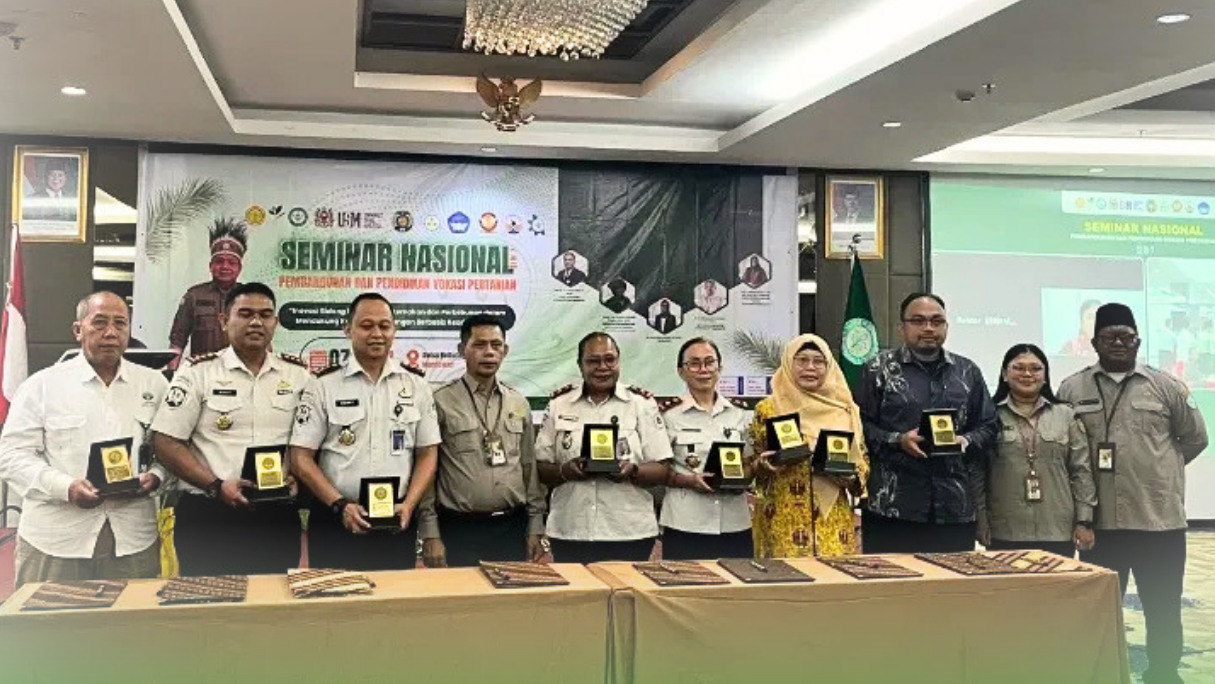
Manokwari, 7 July 2026 – The Faculty of Agriculture, Universitas Sumatera Utara (FP USU) participated in the 7th National Seminar on Agricultural Development and Vocational Education 2026, organized by the Manokwari Agricultural Development Polytechnic (Polbangtan Manokwari), West Papua. The seminar served as a strategic platform to strengthen collaboration among higher education institutions, government agencies, researchers, and industry stakeholders in advancing agricultural innovation to achieve national food self-sufficiency.
Carrying the theme "Innovation in Agriculture, Livestock, and Plantation Sectors to Support Food Self-Sufficiency Based on Local Wisdom," the seminar was officially opened by the Director of Polbangtan Manokwari, represented by the Vice Director II, Dr. Mikhael, S.P., M.Si. A total of 340 presenters from 98 institutions, including several international universities, participated in the scientific forum. The high level of participation reflected the strong commitment of diverse stakeholders to advancing scientific knowledge, innovation, and collaboration in the agricultural sector.
During the plenary session, Assoc. Prof. Ameilia Zuliyanti Siregar, M.Sc., Ph.D., from the Faculty of Agriculture, Universitas Sumatera Utara, delivered a presentation highlighting the importance of implementing appropriate technologies to improve production efficiency, promote sustainable agriculture, and strengthen Indonesia's national food security. She emphasized that innovations such as agricultural mechanization, smart irrigation systems, post-harvest technologies, and the utilization of environmentally friendly local materials can accelerate the transformation of the agricultural sector into a more modern, adaptive, and competitive system.
At the same session, Prof. Ts. Dr. Abdul Hafiz Ab Majid from Universiti Sains Malaysia presented on the role of molecular ecology in identifying pest distribution patterns as a foundation for developing more precise, efficient, and sustainable agricultural management strategies. His presentation broadened participants' perspectives on the importance of integrating science and technology to address the challenges facing the agricultural sector.
In addition to serving as a forum for scientific exchange, the seminar aimed to strengthen inter-institutional collaboration in applied research. The organizing committee announced that all accepted papers would be published in national and international conference proceedings with e-ISSN and DOI, while selected outstanding papers would be recommended for publication in SINTA-accredited scientific journals.
Through stronger academic collaboration and the application of technology and innovation, the seminar is expected to generate solutions that not only enrich scientific publications but also make meaningful contributions to the development of a modern, productive, inclusive, and sustainable agricultural sector in Indonesia.
The participation of the Faculty of Agriculture, Universitas Sumatera Utara, also reflects the faculty's commitment to supporting the Sustainable Development Goals (SDGs). Efforts to promote innovation in strengthening food security and self-sufficiency contribute to SDG 2 (Zero Hunger), while advancing higher education, disseminating research findings, and fostering academic collaboration support SDG 4 (Quality Education). The implementation of appropriate technologies and the development of innovative research contribute to SDG 9 (Industry, Innovation and Infrastructure), while the collaboration among universities, government institutions, researchers, and industry partners embodies SDG 17 (Partnerships for the Goals). Through these collaborative efforts, the Faculty of Agriculture, Universitas Sumatera Utara continues to strengthen its role as a higher education institution dedicated to advancing resilient, competitive, and sustainable agricultural development.