


As part of efforts to strengthen the downstreaming of research outcomes and community service programs, the Universitas Sumatera Utara (USU) Community Service Team conducted a Focus Group Discussion (FGD) titled Formulation of Strategies and Sustainability for Integrated Agricultural Capacity-Building Programs to Support Community Economic Resilience. This academic forum served as a platform for disseminating interdisciplinary community service results as well as formulating applicable policy recommendations for rural development in Simalungun Regency.
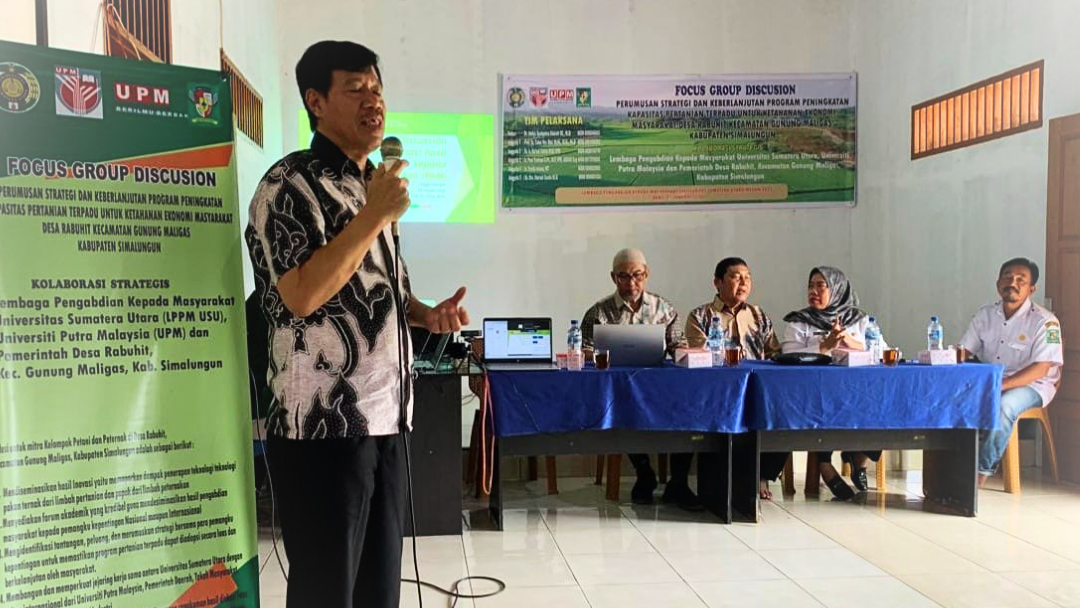
The Head of the Rabuhit Village Assisted Program Team, Dr. Amlys Syahputra Silalahi, SE., M.Si., explained that the activity adopts a collaborative framework connecting national and international academics, government, industry, and local communities. The main focus of the Community Service Team in this FGD was the analysis of economic and environmental impacts of integrated agricultural technology interventions. The team has also developed a roadmap to ensure that innovations in livestock feed and waste management in Rabuhit Village generate long-term impacts.
The forum incorporated international perspectives through the participation of Associate Prof. Nuraini Abdul Azis from Universiti Putra Malaysia (UPM). She presented case studies on the effectiveness of regional integrated farming systems and emphasized the importance of cross-country collaboration in addressing global food security challenges.
From the industrial implementation perspective, Ir. David Yasin, S.Pt., M.Pt. highlighted opportunities for strategic partnerships with the national beef cattle industry. This complemented the academic analysis presented by Dr. Drs. Hariadi Susilo, M.Si., as well as insights from the Institute for Community Service (LPPM USU) represented by Prof. Dr. Tulus, Vor.Dipl.Math., M.Si., Ph.D., regarding methodologies for enhancing rural community capacity.
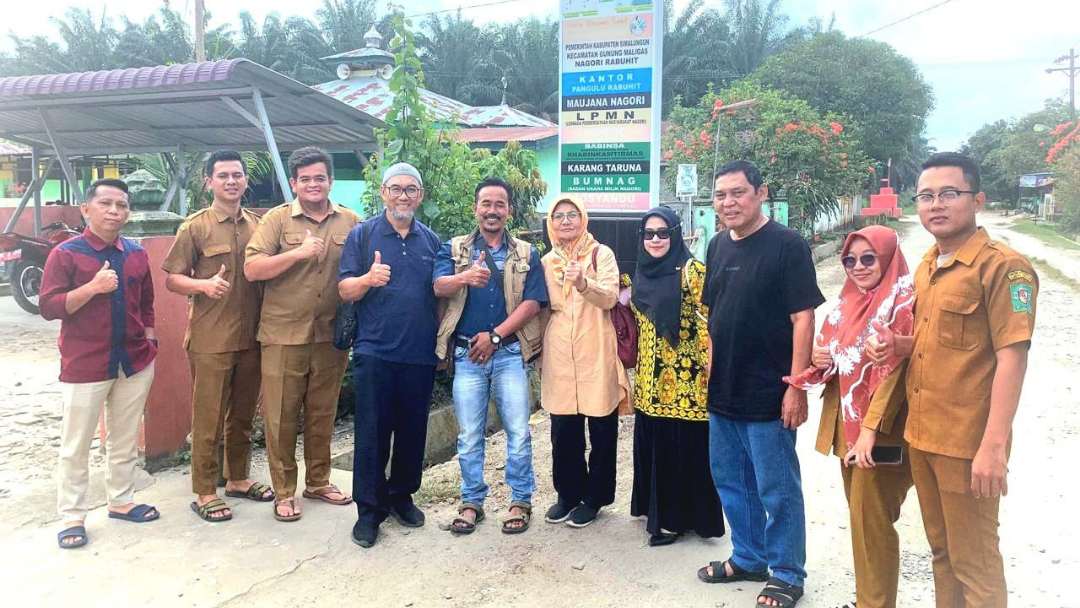
The integration of SDGs 8 in the FGD, presented by Ir. Peni Patriani, S.Pt., M.P., IPM, ASEAN Eng., and Ir. Farida Ariani, M.T., underscored the urgency of incorporating Sustainable Development Goals (SDGs) as the foundation for community service programs in 2026. This program specifically focuses on SDG 8: Decent Work and Economic Growth. Considering that creating quality employment opportunities remains a significant challenge, the USU Community Service Team is committed to building an economic ecosystem in collaboration with the government and industry to foster welfare through stable village economic growth.
The session, presented by Dr. Ir. Ma'ruf Tafsin, M.Si., IPM, resulted in key strategic points documented in a Joint Commitment agreement. This document was signed by key stakeholders, including the Head of Gunung Maligas Subdistrict, Ms. Masrah, and the Head of Rabuhit Village, Mr. Rohiman. The agreement includes operational procedures for integrated agriculture, integration of community service outcomes into village policies, and continuous monitoring to maintain economic stability.
The USU Community Service Team hopes that the model developed in Rabuhit Village can be replicated in other regions as a solution for optimizing community-based agribusiness potential.