


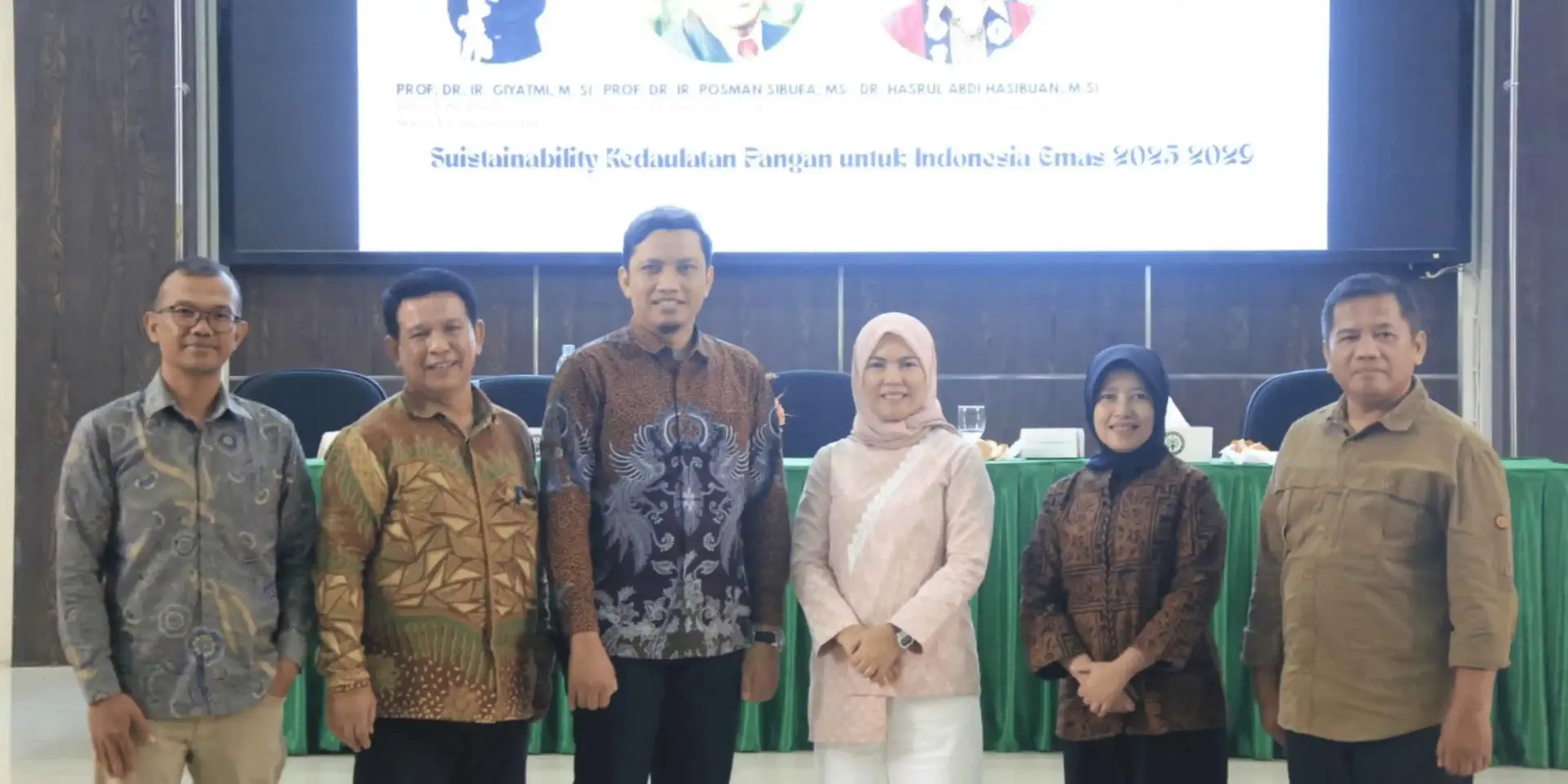
Medan, September 5, 2026 – The Indonesian Food Technologists Association (PATPI) officially inaugurated the Management Boards of the Medan and Kendari Branches for the 2026–2030 period during a General Lecture and Inauguration event themed “Sustainability: Food Sovereignty for a Golden Indonesia,” held in a hybrid format at the Polbangtan Medan Hall on Saturday (September 5, 2026).
The inauguration was led directly by the Chair of PATPI, Giyatmi. For the 2026–2030 period, the PATPI Medan Branch is chaired by Adrian Hilman, S.TP., M.Sc., Ph.D., from Universitas Sumatera Utara (USU). Several members of the USU academic community have also been entrusted with various positions in the management board, strengthening the role of higher education institutions in the development of the profession, research, and innovation in food technology.
During the event, the Minister of Agriculture of the Republic of Indonesia, Andi Amran Sulaiman, emphasized that food sovereignty is an important part of national strength. The utilization of technology, downstreaming, and local resources is considered a strategic step to strengthen national food security while improving farmers’ welfare.
“PATPI has a strategic role in delivering innovations that ensure food security and farmers’ welfare,” said the Minister of Agriculture.
Chair of PATPI, Giyatmi, stated that increasingly complex food challenges require synergy among science, government, industry, and society. PATPI is expected to serve as a bridge that strengthens this collaboration while encouraging each branch to develop the potential of leading food commodities in its respective region.
In line with this, Chair of the PATPI Medan Branch, Adrian Hilman, invited various higher education institutions to strengthen collaboration in addressing food-related issues. According to him, knowledge generated within academic environments needs to be translated into works and innovations that provide tangible benefits to society.
“Food challenges are not a personal matter, but a matter for all of us. Let us build collaboration among higher education institutions in Medan. Turn knowledge into works, works into innovation, and innovation into tangible progress in the food sector,” said Adrian.
The series of activities continued with a general lecture discussing several strategic issues related to the future of food in Indonesia. Giyatmi discussed demographic challenges and the importance of food downstreaming, while Prof. Dr. Ir. Posman Sibuea, M.S. highlighted the potential of Indonesia’s local food resources as a foundation for food sovereignty. Meanwhile, Hasrul Abdi Hasibuan discussed the challenges of climate change to the plantation sector and the opportunities presented by Indonesia’s demographic dividend.
The three topics emphasized the importance of research, technological innovation, local food diversification, reducing food loss, downstreaming, and the ability to adapt to climate change. Higher education institutions are considered to have a strategic position as centers for knowledge and innovation development that can address various food challenges sustainably.
To strengthen the organization’s role, the PATPI Medan Branch for the 2026–2030 period established five main orientations: Professional Growth, Food Innovation, Industry & Government Linkage, Food for Society, and PATPI Community. These five orientations are directed toward improving members’ competencies, encouraging applicable food research and innovation, strengthening relations with industry and government, providing solutions for society, and building an active and collaborative organization.
The involvement of the USU academic community in the management of the PATPI Medan Branch forms part of the contribution of the Faculty of Agriculture, Universitas Sumatera Utara, to strengthening the food ecosystem through education, research, innovation, and partnerships. This collaboration is expected to encourage the development of food technology solutions that are relevant to societal needs while strengthening Indonesia’s food sovereignty.
These efforts are in line with the Sustainable Development Goals (SDGs), particularly SDG 2 (Zero Hunger) through strengthening food security, local food diversification, and sustainable agriculture. The development of competencies and knowledge in food technology also supports SDG 4 (Quality Education), while food innovation and downstreaming that generate added value for society support SDG 8 (Decent Work and Economic Growth). Meanwhile, synergy among higher education institutions, government, industry, professional organizations, and society in building a sustainable food system strengthens SDG 17 (Partnerships for the Goals).