


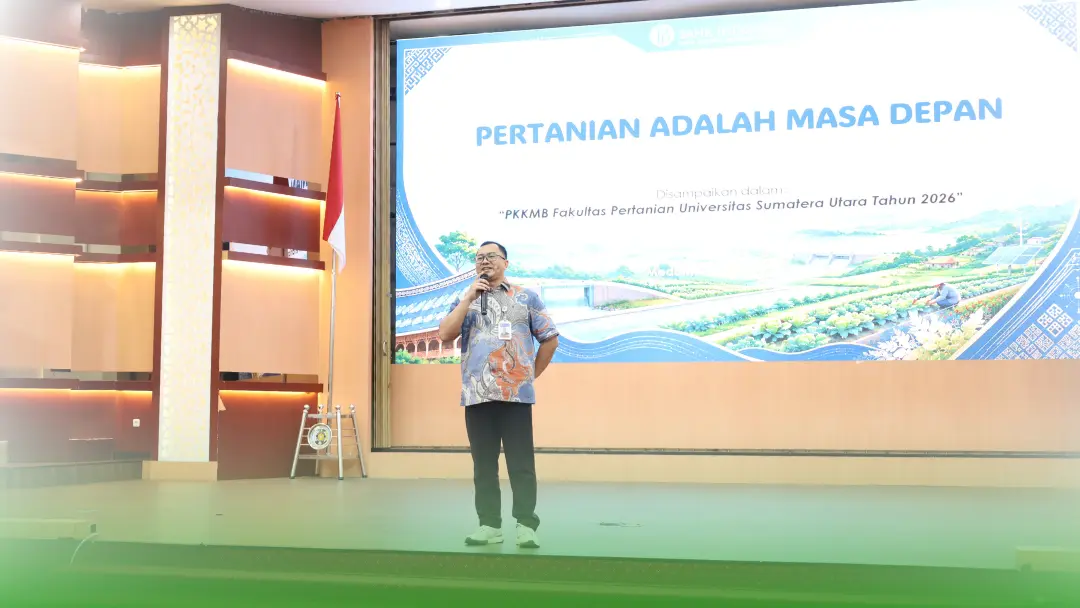
Medan, August 13, 2026 — The second day of the 2026 Campus Life Introduction Program for New Students (PKKMB) at the Faculty of Agriculture, Universitas Sumatera Utara (FP USU), was held on Wednesday (August 13) at the USU Student Center. The session featured Abdul Khalim, Deputy Director of the Representative Office of Bank Indonesia for North Sumatra Province, as the speaker.
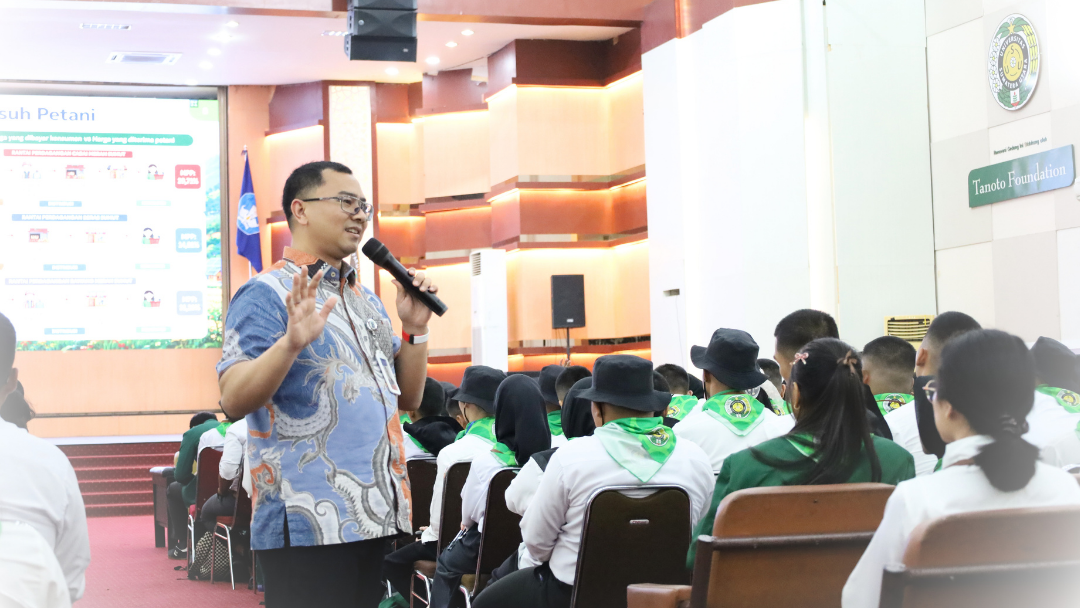
The activity was attended by all 2026 new students of FP USU, as well as the Dean, Vice Deans, Heads and Secretaries of Study Programs, and members of the FP USU academic community. Under the theme “Agriculture is the Future,” Abdul Khalim encouraged new students to view agriculture as a strategic sector with significant potential to support economic development and community welfare. “You made the right choice by choosing Agriculture. Agriculture is not the past. Agriculture is the future,” said Abdul Khalim to the new students of FP USU.
He explained that agricultural transformation requires close collaboration among universities, businesses, government, and farmers. Universities contribute through knowledge development, research, technological innovation, and human resource development. Businesses contribute through investment, financing, market access, partnerships, and downstream development. The government plays a role by providing policies, infrastructure, facilities, regulations, and incentives, while farmers remain the key drivers of production by utilizing product quality, local wisdom, and field experience.
“There can be no agricultural transformation without collaboration,” he emphasized.
Abdul Khalim also reminded students that higher education is not merely about earning a degree but also about developing competencies that remain relevant to changing times. Over the next four years, agriculture students are encouraged to master the fundamentals of agricultural science, digital technology, data and artificial intelligence (AI), communication skills, and networking with industry, government, and research institutions.
Students were also encouraged to produce work through projects, research, and business development. According to him, agriculture graduates have diverse career opportunities, including agripreneurs, researchers, data analysts, innovators, exporters, policymakers, and professionals in financing and investment. “One field of knowledge. Many paths. Don’t just look for jobs in the agricultural sector. Create the future of agriculture,” Abdul Khalim said.
This concept aligns with the idea of the “New Farmer,” referring to a new generation in agriculture that does not merely continue traditional agricultural activities but transforms the sector to become more productive, technology- and data-driven, market-oriented, entrepreneurial, and sustainable. During the session, Abdul Khalim also explained the close relationship between agriculture, food security, inflation, purchasing power, and economic growth. Strong food production contributes to food availability and price stability, which ultimately helps maintain purchasing power and community welfare.
He explained that inflation refers to a general and sustained increase in the prices of goods and services. When uncontrolled, inflation can reduce purchasing power, increase uncertainty, and affect public welfare.
According to him, Bank Indonesia pays close attention to the agricultural sector because of the strong relationship between agricultural production, food prices, inflation, purchasing power, welfare, and economic growth.
Based on the material presented, several commodities contributed to inflation and deflation in July 2026. Commodities contributing to inflation included cayenne pepper, rice, tomatoes, gasoline, and broiler chicken. Meanwhile, commodities contributing to deflation included shallots, gold jewelry, tuna/ambu-ambu fish, oranges, and chicken eggs.
Abdul Khalim emphasized that fluctuations in food prices can be influenced by seasonal production, unstable supply and distribution, and the still limited adoption of agricultural technology. “Inflation is not the enemy of farmers. The issue is not only price, but also how value is distributed along the chain,” he explained.
He also highlighted the importance of synergy between the government and Bank Indonesia in supporting food self-sufficiency and maintaining food price stability through stronger coordination of central and regional programs and increased public confidence in commitments to food security and price stability.
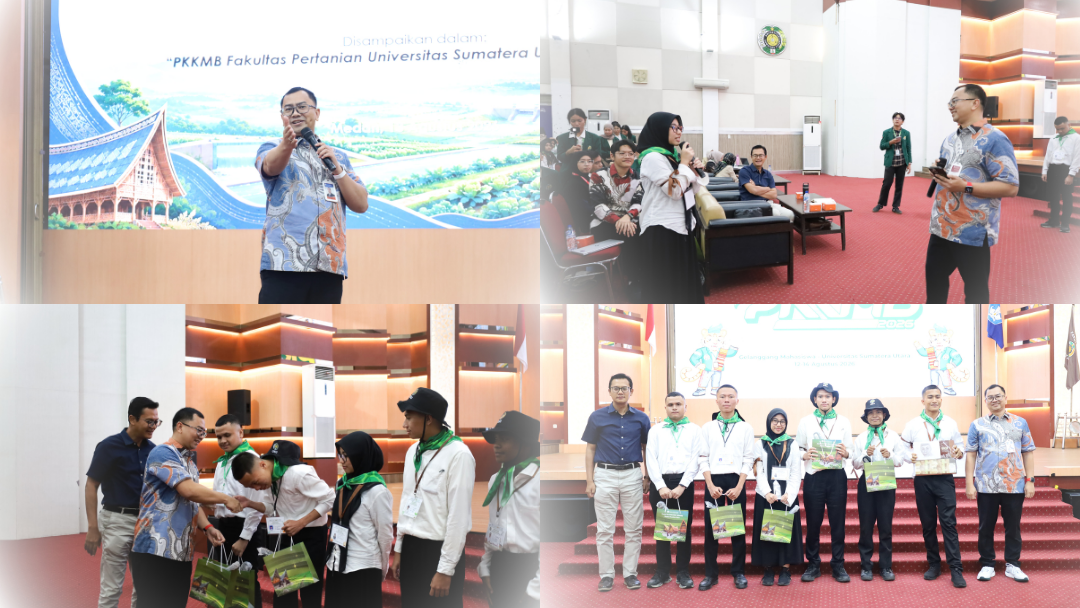
The session was conducted interactively, with new students of FP USU enthusiastically asking questions about the future of agriculture, career opportunities, technology, entrepreneurship, and agricultural development challenges.
To increase student engagement, Bank Indonesia also held a quiz during the session. Several students who successfully answered the questions received prizes.
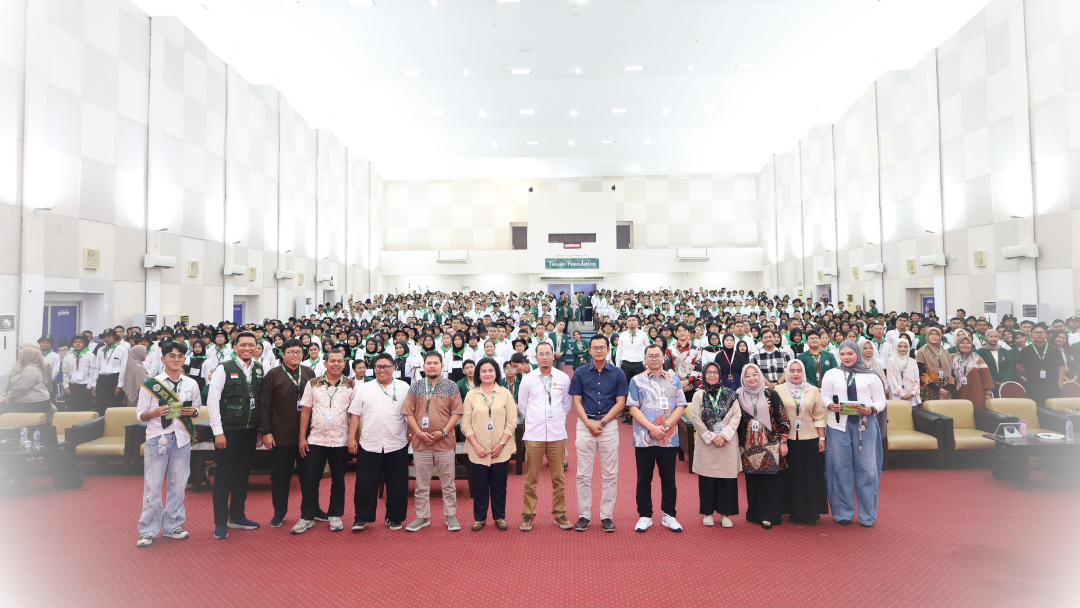
The activity concluded with the presentation of a commemorative plaque from the Faculty of Agriculture USU to Bank Indonesia as an expression of appreciation for its contribution and participation in the 2026 PKKMB FP USU. The event continued with a group photo involving the speaker, faculty leaders, and new students.
The PKKMB session on the future of agriculture, innovation, technology, food security, and sustainable development is closely connected to several Sustainable Development Goals (SDGs).
First, SDG 2: Zero Hunger, through strengthening students’ understanding of food security, agricultural productivity, and sustainable food systems. Second, SDG 4: Quality Education, through providing knowledge and competencies to prepare students for future careers and development challenges. Third, SDG 8: Decent Work and Economic Growth, through encouraging entrepreneurship, innovation, investment, and economic opportunities in the agricultural sector. Fourth, SDG 9: Industry, Innovation and Infrastructure, through the use of technology, data, AI, research, and innovation to support agricultural transformation.
The spirit of collaboration among universities, government, businesses, Bank Indonesia, and farmers also aligns with SDG 17: Partnerships for the Goals, which emphasizes the importance of partnerships in achieving sustainable development.
Through this activity, new students of FP USU are expected not only to understand that agriculture is an essential sector for human life but also to have the courage to become part of its transformation. The younger generation in agriculture is expected to bring forward innovation, develop businesses, conduct research, utilize technology, and create solutions oriented toward community welfare and environmental sustainability.
Agriculture is not merely a field to study; it is a strategic sector that must be prepared for Indonesia’s future.