


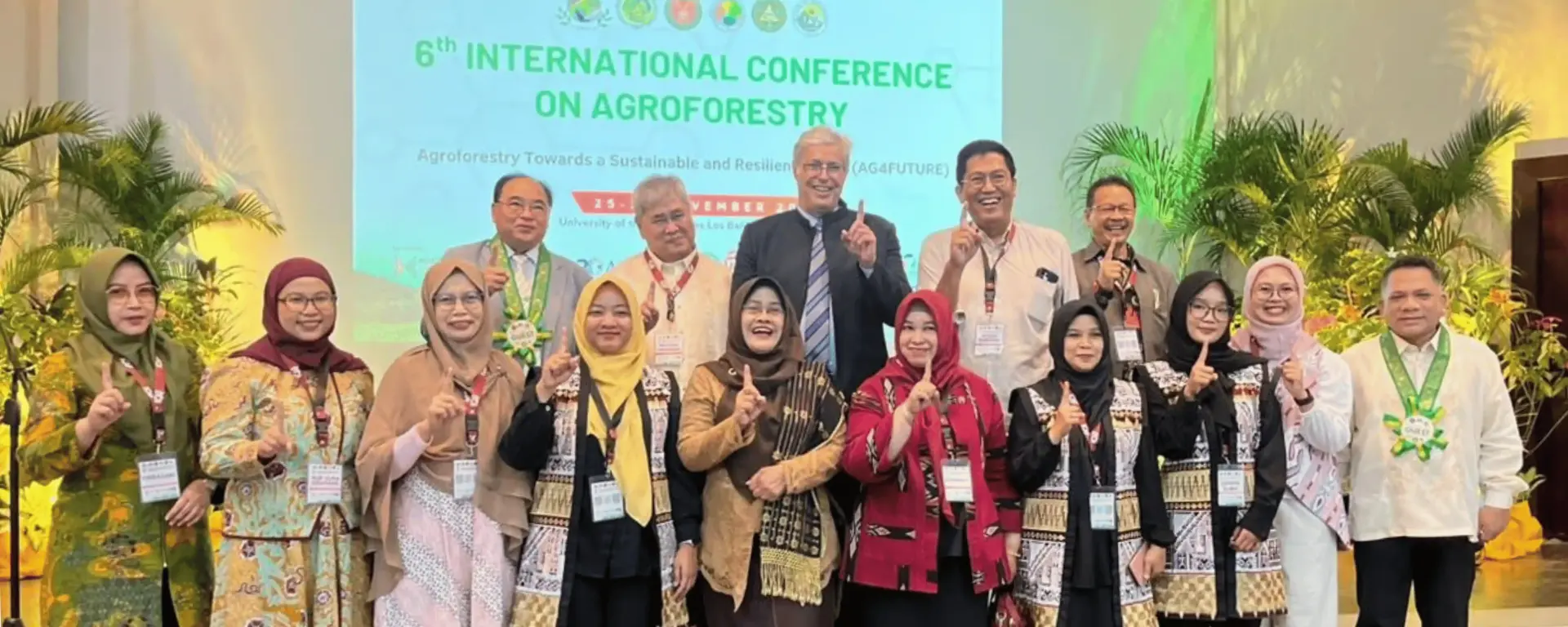
Los Baños, Philippines – The Faculty of Agriculture, Universitas Sumatera Utara (FP USU), continues to strengthen its contribution to supporting sustainable development and climate change resilience through the dissemination of research and community service results at the international level.
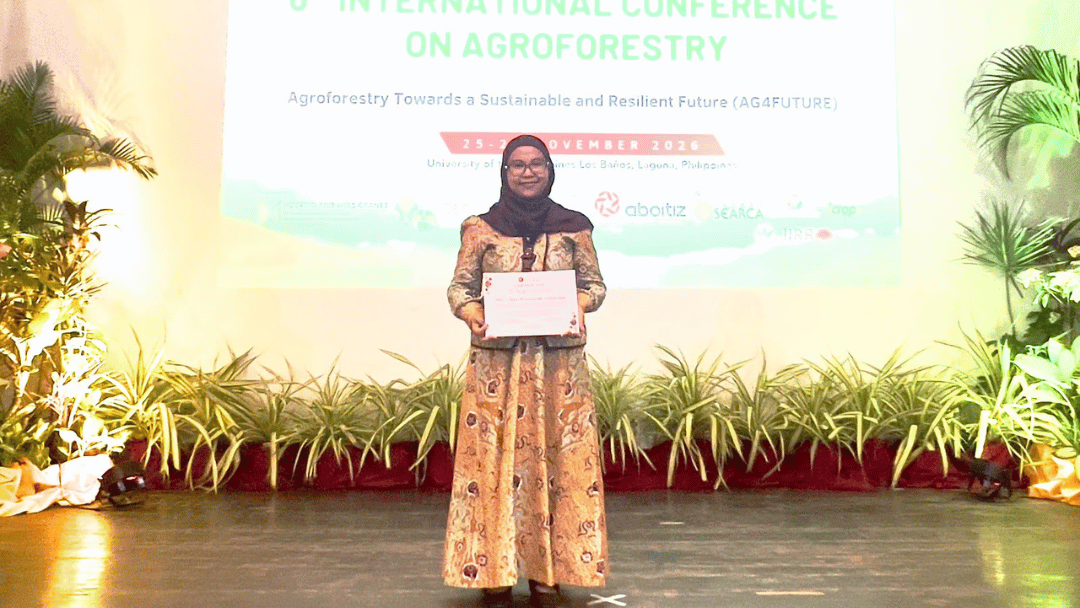
Nur Ulina Warnisyah Sebayang, M.Agr., a lecturer in the Undergraduate Program in Agrotechnology, Faculty of Agriculture, USU, specializing in Soil Ecology and Fertility, participated as a delegate and oral presenter at The 6th International Conference on Agroforestry (ICAF 2026), held on November 25–27, 2026, at the University of the Philippines Los Baños (UPLB), Laguna, Philippines.
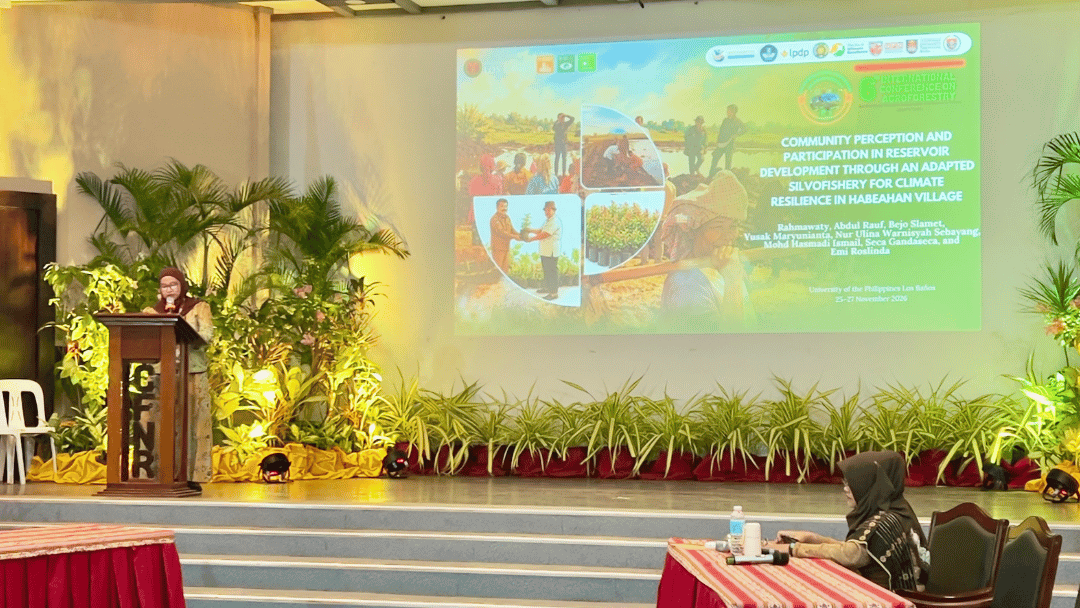
The international conference, themed “Agroforestry Towards Sustainable and Resilient Future (AG4FUTURE),” was organized by the Southeast Asian Network for Agroforestry Education (SEANAFE), the Philippine Agroforestry Education and Research Network (PAFERN), and the University of the Philippines Los Baños (UPLB) through the Institute of Agroforestry, College of Forestry and Natural Resources.
The theme is closely related to the fields of soil ecology and fertility, particularly in understanding the interactions between soil, water, vegetation, and soil organisms in supporting ecosystem functions, land productivity, food security, and environmental resilience to climate change.
Dissemination of Research-Based Community Service Results through the 2025–2026 LPDP Equity Program
On this occasion, Nur Ulina Warnisyah Sebayang, M.Agr., presented a scientific paper entitled “Community Perception and Participation in Reservoir Development through an Adapted Silvofishery for Climate Resilience in Habeahan Village” during the Enhancing Climate Resilience through Agroforestry session on Wednesday, November 25, 2026, at Lansigan Auditorium, UPLB.
The scientific paper was based on research-based community service activities conducted through the International Community Development program, funded by the 2025–2026 Equity Program of the Indonesia Endowment Fund for Education (LPDP) through the Institute for Research and Community Service (LPPM), Universitas Sumatera Utara.
The community service program was led by Prof. Dr. Ir. Abdul Rauf, M.P., Professor at the Faculty of Agriculture, USU, specializing in Soil and Water Conservation, with team members Prof. Ir. Rahmawaty, S.Hut., M.Si., Ph.D., IPU., and Dr. Ir. Bejo Slamet, S.Hut., M.Si., IPM., from the Faculty of Forestry, USU, as well as Ir. Yusak Maryunianta, M.P., and Nur Ulina Warnisyah Sebayang, M.Agr., from the Faculty of Agriculture, USU.
The activity also involved national and international academic collaborations with Prof. Dr. Mohd Hasmadi bin Ismail from the Faculty of Forestry and Environment, Universiti Putra Malaysia (UPM); Assoc. Prof. Dr. Ir. Seca Gandaseca, M.Sc., from Universiti Teknologi MARA (UiTM), Malaysia; and Prof. Dr. Emi Roslinda, S.Hut., M.Si., from the Faculty of Forestry, Universitas Tanjungpura (Untan), Indonesia.
This collaboration integrates various academic disciplines, ranging from soil and water conservation, soil ecology and fertility, forest management, hydrology, agricultural socioeconomics, to community empowerment, in support of sustainable and climate-resilient village development.
This research-based community service initiative focuses on reservoir development through a community empowerment approach and the adaptation of a silvofishery system in Habeahan Village, Lintong Nihuta District, Humbang Hasundutan Regency, North Sumatra.
Reservoir development is one of the strategies for increasing water resource availability, controlling surface runoff, supporting soil and water conservation, and strengthening community resilience to hydrometeorological disaster risks and climate change.
Research findings from 38 respondents showed that 73.7 percent of the community had a high perception of reservoir development, with active participation reaching 78.9 percent. These findings demonstrate the importance of community involvement in supporting sustainable natural resource management and the development of climate-resilient villages.
Integrating Soil Ecology and Fertility into Sustainable Agroforestry Development
Nur Ulina Warnisyah Sebayang, M.Agr.'s participation in this international conference also served as an opportunity to strengthen the contribution of soil ecology and fertility to the development of sustainable and climate-adaptive agroforestry systems.
Soil is a fundamental component of agroforestry systems, playing a role in nutrient cycling, carbon storage, water regulation, soil biological activity, and the sustainability of ecosystem productivity.
The integration of vegetation with soil and water resource management through agroforestry approaches has the potential to increase soil organic matter content, support soil organism biodiversity, improve soil fertility, reduce erosion risks, and maintain the ecological balance of a landscape.
In the context of silvofishery-based reservoir development, the soil ecology approach is relevant to supporting soil and water conservation, maintaining soil moisture in surrounding areas, and creating environmental conditions that support vegetation growth and the sustainability of ecosystem functions.
Well-managed water resource availability also plays an important role in supporting soil organism activities, organic matter decomposition processes, and nutrient cycling, which are essential for maintaining soil fertility and agricultural land productivity.
Synergy between soil science, agroforestry, water resource management, and community empowerment represents a relevant multidisciplinary approach to realizing the theme of ICAF 2026: agroforestry towards a sustainable and resilient future.
Strengthening National and International Academic Collaboration
In addition to the Faculty of Agriculture delegation, Universitas Sumatera Utara was also represented by Prof. Ir. Rahmawaty, S.Hut., M.Si., Ph.D., IPU., Professor at the Faculty of Forestry, USU, as an oral presenter with a scientific paper entitled “Above Ground Carbon Stock Estimation of Urban Vegetation in Medan City Using PlanetScope Imagery and Machine Learning Algorithms” during the Ecosystem Services of Agroforestry session.
The research integrates remote sensing technology and machine learning algorithms to estimate carbon stocks in urban vegetation as part of efforts to support climate change mitigation and sustainable urban environmental management.
The international conference was also attended by several delegates from other Indonesian universities, namely Prof. Dr. Emi Roslinda, S.Hut., M.Si., from the Faculty of Forestry, Universitas Tanjungpura (Untan); Prof. Dr. Ir. Christine Wulandari, M.P., Dr. Rommy Qurniati, S.P., M.Si., Machya Kartika Tsani, S.Hut., M.Sc., and Firdasari, S.P., M.E.P., Ph.D., from the Department of Forestry, Faculty of Agriculture, Universitas Lampung (Unila); and Khaerani Nurlaelita, S.Hut., M.Sc., from the Faculty of Agriculture, Universitas Jember (Unej), who participated as poster presenters.
Prof. Christine Wulandari was also entrusted with chairing the Enhancing Climate Resilience through Agroforestry session at the international conference.
ICAF 2026 featured Dr. Dennis P. Garrity, Board Chair of the Healthy Planet Action Coalition and former Director General of the World Agroforestry Centre (ICRAF), as the keynote speaker.
The conference also featured five plenary speakers, namely Assoc. Prof. Dr. Weerapon Thongma from Maejo University, Thailand; Dr. David Ganz from the Regional Community Forestry Training Center for Asia and the Pacific (RECOFTC); For. Ruel I. Perez from the Baslay Highland Agriculture Cooperative (BASHACO); Dr. Rachmat Mulia from the Landscape Alliance-Philippines (CIFOR-ICRAF in Action); and For. Arturo E. Fadriquela from the Forest Management Bureau, Department of Environment and Natural Resources (DENR), Philippines.
The presence of academics from various countries provided a strategic opportunity to expand research networks, exchange knowledge, develop internationally reputable scientific publications, and create opportunities for cross-border collaboration in education and community service.
The Faculty of Agriculture, USU's Contribution to Achieving the SDGs
The dissemination of research-based community service results through ICAF 2026 represents part of the Faculty of Agriculture, USU's contribution to supporting the achievement of the Sustainable Development Goals (SDGs), particularly:
SDG 2 – Zero Hunger, through the development of sustainable agricultural and fisheries systems that support community food security.
SDG 4 – Quality Education, through knowledge dissemination, academic capacity development, and the exchange of scientific experiences at the international level.
SDG 6 – Clean Water and Sanitation, through the sustainable conservation and management of water resources.
SDG 13 – Climate Action, through the development of ecosystem-based climate change adaptation and mitigation strategies and community empowerment.
SDG 15 – Life on Land, through soil and water conservation, soil fertility management, and the strengthening of agroforestry's ecological functions.
SDG 17 – Partnerships for the Goals, through strengthening multidisciplinary collaboration, cross-faculty cooperation, and national and international academic partnerships.
Participation in ICAF 2026 also represents the implementation of the three pillars of higher education and the internationalization of Universitas Sumatera Utara through the dissemination of outputs from the LPDP Equity Program to the global scientific community.
Through the integration of expertise in soil ecology and fertility, natural resource conservation, agroforestry, and community empowerment, the Faculty of Agriculture, USU, continues to promote the development of research-based innovations that positively impact communities and support the creation of productive, sustainable, and climate-resilient ecosystems.
Participation in this international conference also reinforces Universitas Sumatera Utara's commitment as a higher education institution oriented towards academic excellence, global collaboration, and tangible contributions to achieving sustainable development goals.