


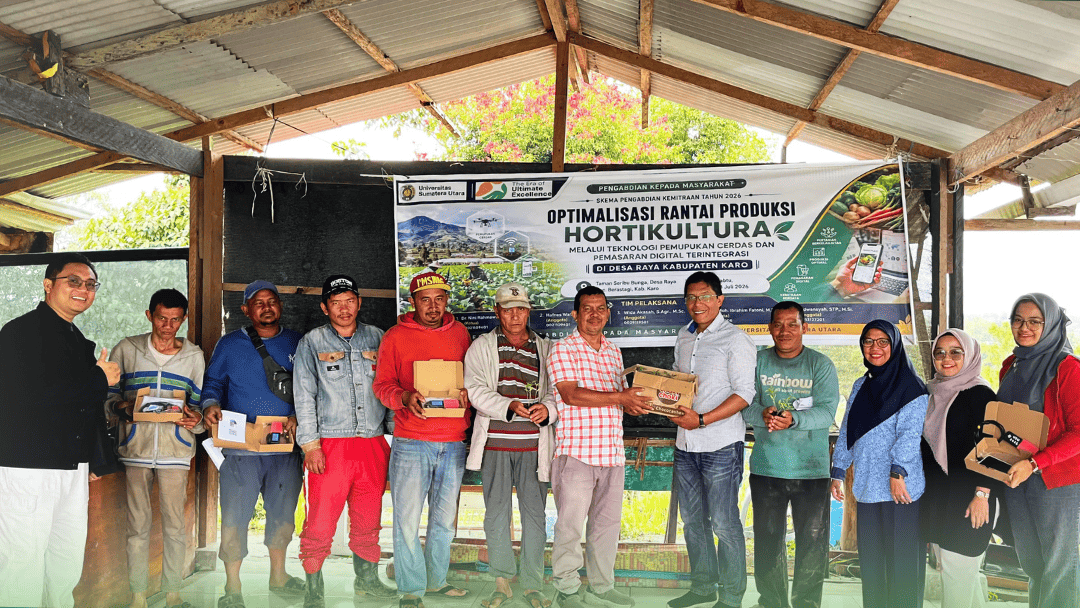
On July 18, 2026, the Community Service (PKM) Team under the Community Partnership Scheme from the Faculty of Agriculture, Universitas Sumatera Utara (USU), carried out another community assistance program in Raya Village, Berastagi District, Karo Regency, North Sumatra. Titled "Optimizing the Horticultural Production Chain through Smart Fertilization Technology and Integrated Digital Marketing in Raya Village, Karo Regency," the program targets horticultural farmers affiliated with the Arih Ersada Village-Owned Enterprise (BUMDes) and is designed to support the achievement of several Sustainable Development Goals (SDGs).
This initiative is a continuation of a long-term collaboration between the Faculty of Agriculture USU and BUMDes Arih Ersada, which has previously produced a series of community engagement activities in the Thousand Flowers Park (Taman Seribu Bunga), Raya Village, including agritourism development and management in previous years.
The project is led by Dr. Nini Rahmawati, S.P., M.Si. (Department of Agrotechnology), with the following team members:
- Hafnes Wahyuni, S.P., M.P. – Department of Agrotechnology, Plant Breeding Specialist
- Wida Akasah, S.Agr., M.Sc. – Soil Science Specialist
- R. B. Moh. Ibrahim Fatoni, M.P. – Agribusiness Specialist
- Ridwansyah, S.T.P., M.Si. – Food Technology Specialist
The program also involves five students from the Faculty of Agriculture USU as part of their experiential learning activities outside the classroom.
Addressing Local Challenges
Raya Village possesses significant horticultural potential, particularly in vegetable and fruit cultivation, supported by favorable agroclimatic conditions at an elevation of 375 meters above sea level and annual rainfall of 2,000–2,500 mm. However, horticultural productivity has yet to reach its full potential due to several challenges, including fertilization practices that rely on traditional experience rather than precise nutrient data, fluctuating crop productivity and quality, dependence on conventional distribution chains through middlemen, and limited digital literacy among farmers in utilizing online marketing platforms.
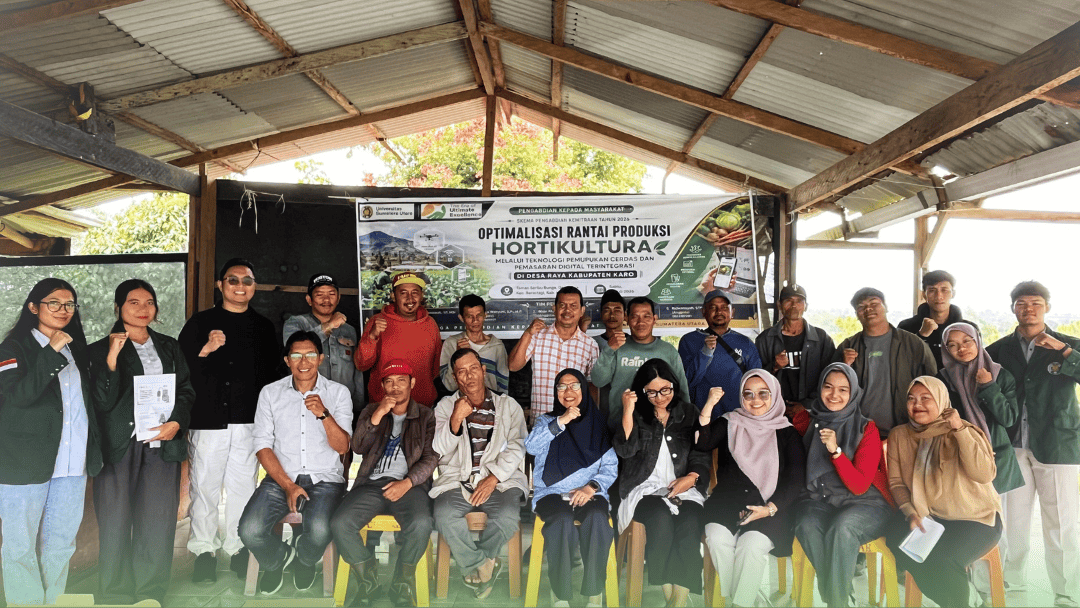
To address these challenges, the team implemented a participatory approach consisting of soil fertility mapping and analysis on demonstration plots to develop precision fertilization recommendations for key crops such as potatoes, cabbage, and tomatoes; installation and training on digital sensors (including soil moisture, pH, and basic nutrient sensors) integrated with an Android-based monitoring application; training on producing liquid organic fertilizer and compost from local agricultural waste; integrated digital marketing training through online marketplaces and social media; and mentoring on digital record-keeping systems covering cultivation through product distribution.
According to Dr. Nini Rahmawati, the project leader, this data- and sensor-based approach is expected to reduce production costs, improve fertilizer use efficiency, and enhance both the quality and quantity of crop yields.
"Traditional fertilization practices based primarily on experience will be replaced with a more precise approach that meets the specific nutrient requirements of crops at each stage of growth," she explained.
Meanwhile, Karya Jaya Ginting, Director of BUMDes Arih Ersada, expressed appreciation for the continued partnership with the Faculty of Agriculture USU and hopes the program will strengthen the institutional capacity of the village enterprise in managing horticultural production more professionally and sustainably.
As a sustainability-oriented community service initiative, the program directly contributes to:
- SDG 2 (Zero Hunger) by improving fertilization efficiency and horticultural productivity to strengthen local food security;
- SDG 1 (No Poverty) and SDG 8 (Decent Work and Economic Growth) by expanding farmers' access to digital markets, thereby increasing income and improving their bargaining position;
- SDG 17 (Partnerships for the Goals) through collaboration among the university, BUMDes, and local farmer groups.
The program also supports the achievement of Indonesia's Higher Education Key Performance Indicators (IKU), particularly IKU 2 (Students Gain Off-Campus Learning Experiences), IKU 3 (Lecturers Engage in Off-Campus Activities), and IKU 5 (Lecturers' Work Benefits Society).
Funded through the 2026 Non-State Budget (Non-PNBP) LPPM USU TALENTA Scheme, the eight-month community service program runs from April to November 2026.