


The Faculty of Agriculture of Universitas Sumatera Utara (FP USU) organized a public lecture themed “Bank Indonesia’s Synergy in Supporting Asta Cita: Building Food Security and Farmers’ Welfare through Agricultural Modernization and Downstreaming” at the Suratman Hall of FP USU on Monday (09/02).
The event featured the Head of the Representative Office of Bank Indonesia for North Sumatra Province, Dr. Rudy Brando Hutabarat, as the main speaker, with Dr. Rulianda Purnomo Wibowo, S.P., M.Ec., Chair of the Agribusiness Study Program of FP USU, serving as moderator. The event was attended by faculty leaders, lecturers, educational staff, and students from various faculties as a forum to strengthen understanding of the strategic role of the agricultural sector in maintaining economic stability and controlling regional inflation.
The event was opened with remarks from the Dean of the Faculty of Agriculture USU, Prof. Dr. Ir. Tavi Supriana, MS. In her remarks, she emphasized the importance of collaboration between higher education institutions and policymakers in addressing challenges in the agricultural sector, particularly in increasing productivity, added value, and farmers’ welfare in North Sumatra. She also expressed hope that the activity would broaden students’ insights into the interconnection between the agricultural sector, macroeconomic dynamics, and monetary policy.
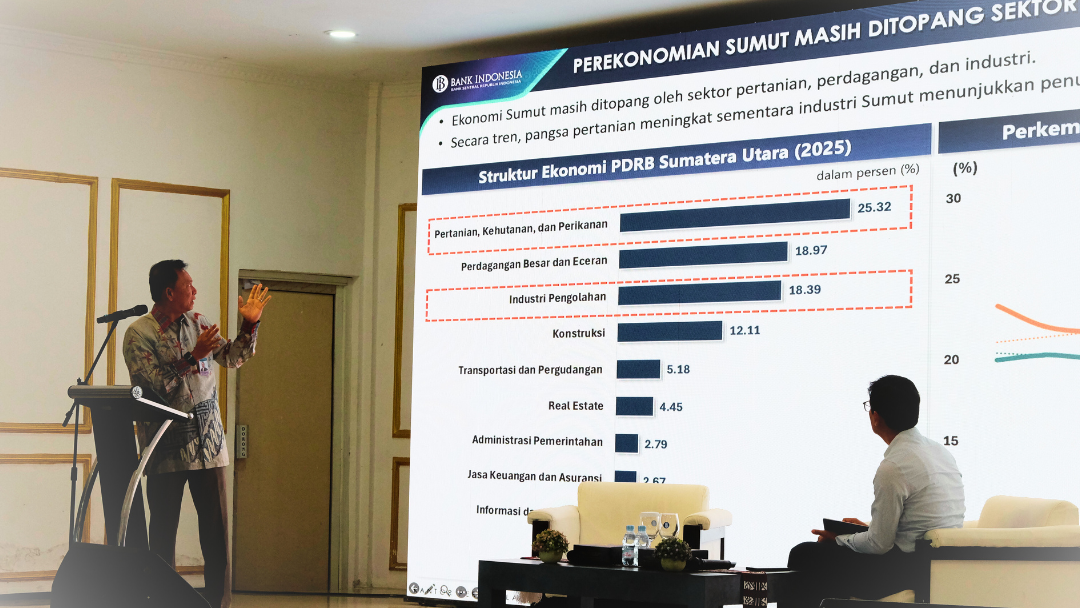
Entering the main session, Dr. Rudy Brando Hutabarat presented the conditions and challenges of the North Sumatra economy. He explained that Indonesia’s economic transformation is directed toward achieving high, sustainable, and inclusive growth in order to avoid the middle-income trap. The period 2025–2029 was referred to as the phase of “strengthening economic foundations” through downstreaming, research and innovation, and productivity improvement.
Regionally, the economy of North Sumatra is still supported by the agricultural, trade, and manufacturing sectors. However, in recent years, the industrial sector has shown a declining trend, while the share of agriculture has tended to increase. This condition faces challenges in the form of slowing consumption, declining government spending, and the impact of natural disasters.
In the context of strengthening economic foundations, Dr. Rudy emphasized that investment must be based on strengthening the real sector and increasing community income. Without stable income from productive activities, investment will not have a real impact on economic growth. “Investment is allowed, investment is necessary. But for those who have work income. If they do not have work income, in my terms it is the same as meaningless,” he said.
From the inflation perspective, the food group has become the main source of pressure. The average contribution of the food group to total monthly inflation from 2022 to January 2026 reached 54.62 percent. Increases in rice prices and horticultural commodities such as red chili, shallots, and cayenne pepper—affected by seasonal factors and limited use of agricultural technology—have been the main triggers of price volatility and have impacted people’s purchasing power.
Furthermore, he highlighted the main challenges of the agricultural sector, including low mechanization, limited human resources and extension workers, minimal regeneration of young farmers, and limited post-harvest processing and downstreaming that result in low added value of products.
In response, Bank Indonesia encourages agricultural transformation through modernization, institutional strengthening, increased investment, and the development of an integrated agricultural ecosystem from upstream to downstream. Appropriate inflation control strategies are expected to protect vulnerable communities, reduce social and economic inequality, and improve public welfare.
The activity continued with an interactive discussion and question-and-answer session. Students and lecturers enthusiastically raised questions regarding Bank Indonesia’s role in stabilizing food prices, opportunities for campus-based innovation-driven downstreaming, and strategies to encourage the regeneration of young farmers.
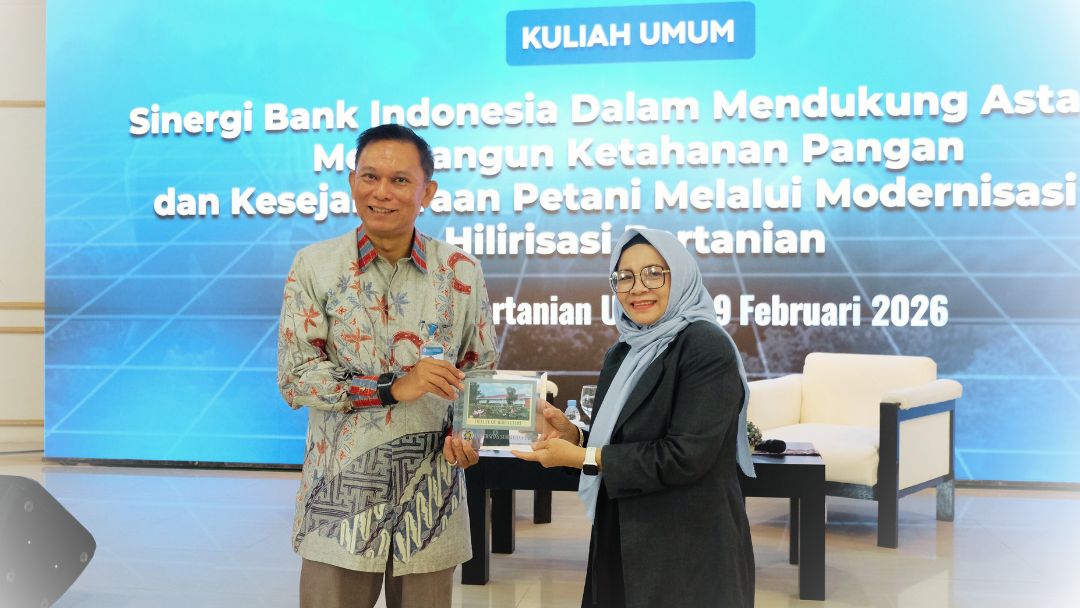
As a form of appreciation and institutional synergy strengthening, the event was closed with the exchange of souvenirs between the Faculty of Agriculture USU and Bank Indonesia for North Sumatra Province. The series of activities was further enlivened by an interactive quiz organized by the Bank Indonesia committee and actively participated in by students.
Through a triple helix synergy among Bank Indonesia, the Regional Government, and higher education institutions, collaboration is directed toward strengthening campuses as centers for food productivity development, innovation-based downstreaming, and reinforcing the role of universities as think tanks and incubators of agricultural human resources.
This public lecture became a strategic momentum to strengthen collaboration in driving agricultural modernization and downstreaming as the foundation of food security as well as inflation control in North Sumatra.