


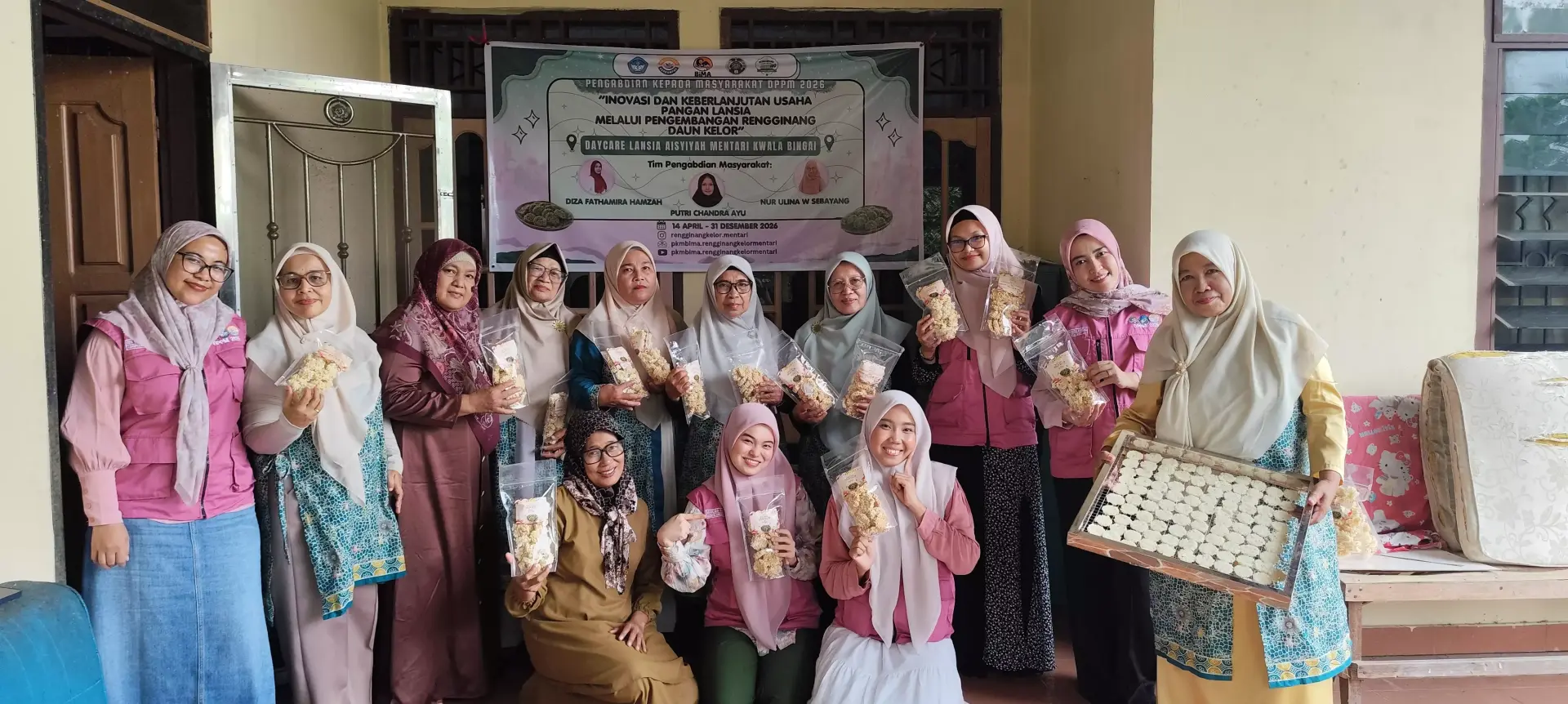
Universitas Sumatera Utara (USU), through its community service team, carried out an initiative titled “Innovation and Sustainability of Elderly Food Enterprises through the Development of Moringa Leaf Rengginang at Aisyiyah Mentari Elderly Daycare, Kwala Bingai.” The activity is part of the university’s efforts to introduce applicable innovations, empower communities, and promote the utilization of local food resources into value-added products with economic potential.
This community service activity was funded by the Ministry of Higher Education, Science, and Technology through the Directorate of Research and Community Service (DPPM) in 2026. The funding support plays an important role in promoting activities focused on the application of science and technology, community empowerment, and strengthening the sustainability of businesses based on local resources.
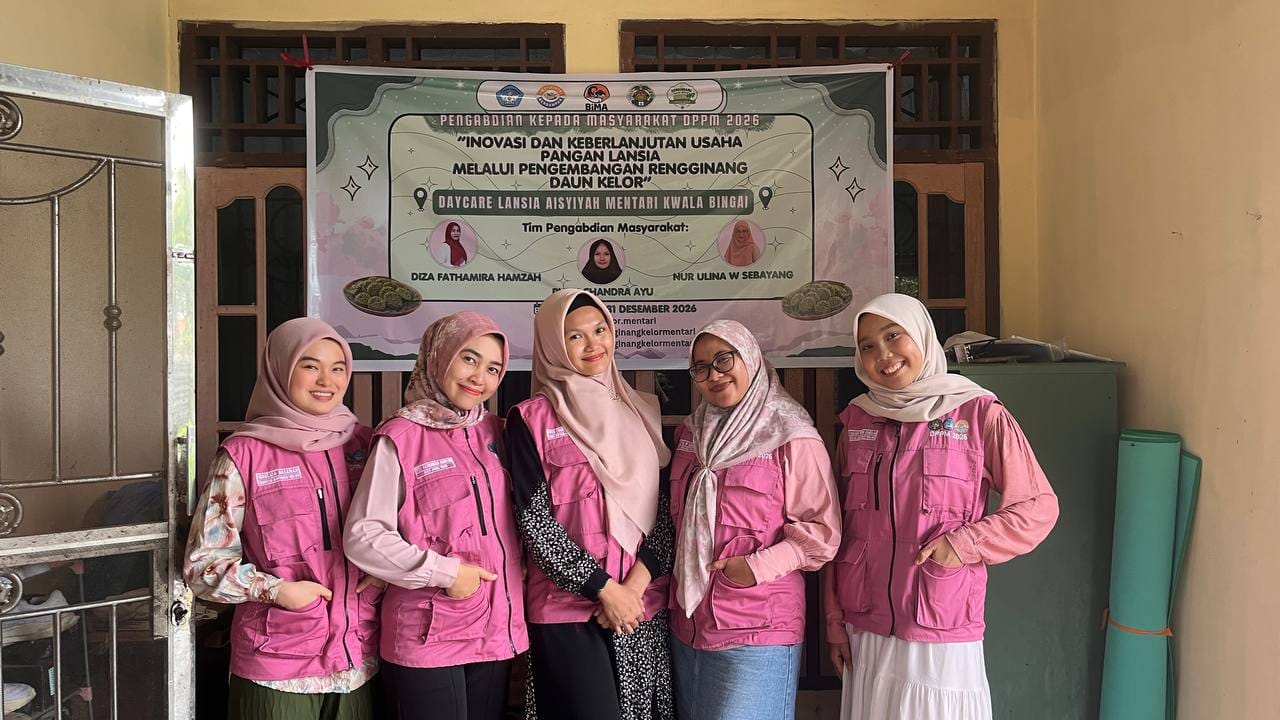
The program was led by Putri Chandra Ayu, S.T.P., M.Si. from the Undergraduate Program in Agricultural and Biosystems Engineering, Faculty of Agriculture, USU, with team members Nur Ulina Warnisyah Sebayang, M.Agr. from the Undergraduate Program in Agrotechnology, Faculty of Agriculture, USU, and Diza Fathamira Hamzah, S.K.M., M.Kes. from the Undergraduate Program in Public Health, Faculty of Public Health, USU.
The cross-disciplinary collaboration is one of the key strengths of this community service initiative, integrating perspectives from agricultural technology and food processing, plant cultivation, as well as nutrition and public health. This multidisciplinary approach allows the development of moringa leaf rengginang to be viewed not only as a food product innovation but also as part of community empowerment, partner capacity building, and sustainable food business development.
Developing Local Potential into Food Innovation
Moringa leaves are one of the local commodities with potential for development into various value-added food products. Through this initiative, moringa leaves are utilized as one of the ingredients in producing moringa leaf rengginang, resulting in an innovative food product with distinctive characteristics and promising market potential.
The application of food processing knowledge and technology is expected to help partners produce products that are more consistent, hygienic, have a longer shelf life, and offer greater economic value.
Product development is not solely focused on the final rengginang product but is also directed toward improving the partners’ skills, knowledge, and capacity so that the introduced innovation can continue to be developed after the community service program concludes.
Empowering Older Adults through Productive Activities
The activities at Aisyiyah Mentari Elderly Daycare also place older adults at the center of the empowerment process. Food processing activities are carried out while considering the abilities and conditions of the participants, allowing them to serve as enjoyable and educational productive activities while providing opportunities for social interaction and skills development.
Through this initiative, older adults are positioned not merely as beneficiaries but also as active participants in the product creation and business development process. This approach is expected to encourage independence, self-confidence, productivity, and meaningful engagement among older adults within their community.
Yumina, Chairperson of Aisyiyah Mentari Elderly Daycare, expressed her appreciation for the initiative, noting that the activities conducted with the USU team provided valuable knowledge and new experiences in food processing while broadening the partners’ understanding of the potential for developing local products into business activities.
The appreciation from the partner demonstrates that collaboration between higher education institutions and communities can generate initiatives that respond to real needs in the field. The community service team hopes that the innovation introduced can continue to be independently and sustainably developed by the partners.
Cross-Disciplinary Collaboration for Sustainable Impact
The initiative demonstrates the importance of cross-disciplinary collaboration in addressing community needs. The Undergraduate Program in Agricultural and Biosystems Engineering contributes through food processing technology and the application of appropriate technology; the Undergraduate Program in Agrotechnology supports the utilization and development of plant-based resources; while the Undergraduate Program in Public Health strengthens the food and nutrition aspects, health education, healthy lifestyle practices, and efforts to improve the quality of life and well-being of older adults.
The synergy among these three disciplines is expected to produce more comprehensive innovations, covering raw material utilization, processing, product quality, nutritional considerations, and business development opportunities.
Thus, the community service initiative goes beyond knowledge transfer and seeks to establish an empowerment ecosystem based on local food innovation.
Furthermore, the activity is aligned with several Sustainable Development Goals (SDGs):
- SDG 2 – Zero Hunger: The utilization of moringa leaves as a food ingredient supports food diversification and the use of local food resources. The development of processed food products also contributes to increasing the value and utilization of locally available food resources.
- SDG 3 – Good Health and Well-being: The initiative supports the well-being of older adults through productive activities, social interaction, skills development, and the introduction of food products that consider nutritional aspects.
- SDG 8 – Decent Work and Economic Growth: The development of moringa leaf rengginang is aimed at improving skills and creating opportunities for food business development. The resulting product has the potential to become an economically valuable product that supports the sustainability of the partners’ productive activities.
- SDG 12 – Responsible Consumption and Production: Transforming local food resources into value-added products represents an effort to optimize resources available within the community. Food processing innovation also encourages more effective and sustainable production practices.
-
SDG 17 – Partnerships for the Goals: The initiative represents a tangible collaboration among Universitas Sumatera Utara, the community, and Aisyiyah Mentari Elderly Daycare. Cross-disciplinary and cross-institutional synergy serves as an important foundation for creating meaningful and sustainable impact.
From Local Potential to Independence and Sustainability
With support from the Ministry of Higher Education, Science, and Technology through DPPM 2026, this community service initiative represents a tangible contribution by higher education institutions to applying science and technology in addressing community needs.
The development of moringa leaf rengginang is more than simply creating a new food product. More broadly, the initiative brings together technological innovation, local food potential, nutritional considerations, elderly empowerment, and business development opportunities within a single sustainability-oriented program.
Going forward, the innovation is expected to continue developing through improvements in product quality and consistency, packaging design and branding, production capacity, marketing strategies, and the strengthening of the partners’ business institutions.
In this way, the benefits of the initiative will not end when the community service program concludes but can continue to be experienced and developed by the community.
From local potential to innovation. From innovation to business opportunities. From empowerment to independence. Together with the community, USU continues to deliver innovation for sustainable development.