


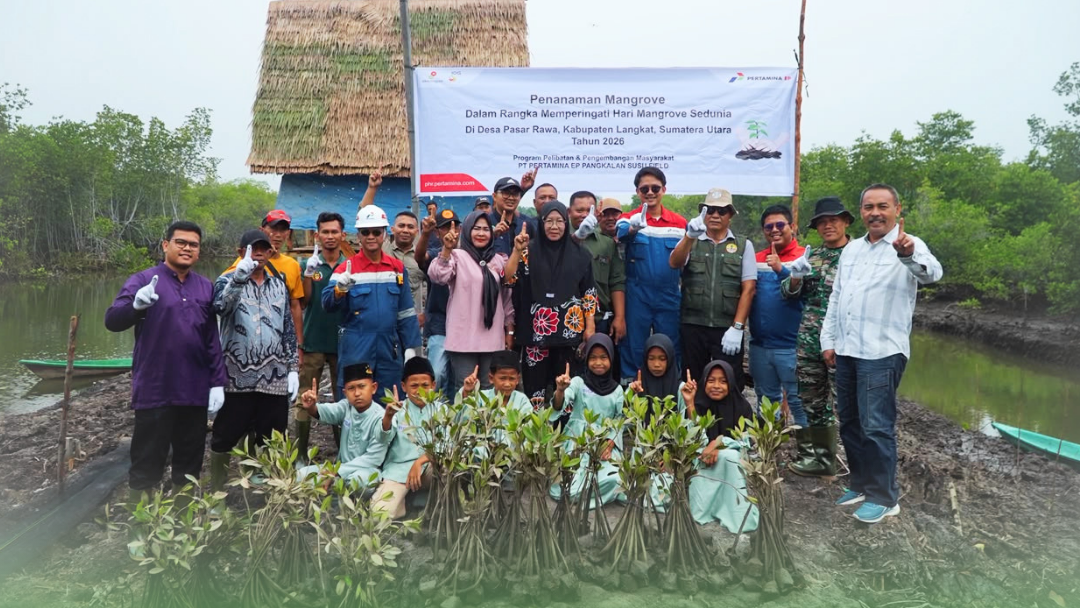
Langkat, July 17, 2026 – The Aquatic Resources Management Study Program (MSP) of the Faculty of Agriculture, Universitas Sumatera Utara (USU) continues to demonstrate its commitment to sustainable coastal resource management by contributing its academic expertise to community development. As part of this commitment, Nur Rohim, S.Pi., M.Si., a lecturer in the MSP Study Program, served as a resource person in the training program entitled "Enhancing Fisheries Management and Aquaculture Capacity through Silvofishery," held on Friday, July 17, 2026.
The training took place at the KTH Penghijauan Maju Bersama Hut in Pasar Rawa Village, Gebang District, Langkat Regency, as part of the Pasar Rawa Mangrove Edu-Ecotourism Program, supported through the Community Involvement and Development Program (PPM) of PT Pertamina EP Pangkalan Susu Field. The initiative aims to strengthen the capacity of coastal communities in managing silvofishery areas as a model of aquaculture integrated with mangrove ecosystem conservation.
As part of the coastal ecosystem restoration efforts, the program began with the planting of 2,500 mangrove seedlings by the Community Development Officer (CDO) of PT Pertamina EP Pangkalan Susu together with members of the KTH Penghijauan Maju Bersama Forest Farmer Group. The activity was complemented by the release of fish fingerlings as an implementation of the silvofishery concept, which integrates mangrove rehabilitation with sustainable aquaculture on a 1.5-hectare demonstration site.
The event opened with remarks from Kasto Wahyudi, Chair of KTH Penghijauan Maju Bersama, a representative of the Head of Forest Management Unit (KPH) Region I Stabat, and Edwin Susanto, Field Manager of PT Pertamina EP Pangkalan Susu. A total of 30 members of KTH participated in the training, which covered the principles of silvofishery management, the ecological functions of mangrove ecosystems, effective aquaculture techniques, and strategies for providing natural and supplemental feed to improve fish production while maintaining environmental sustainability.
During his presentation, Nur Rohim emphasized that silvofishery is not solely intended to increase aquaculture productivity but also serves as an important approach to maintaining the ecological balance of coastal ecosystems. According to him, successful mangrove management requires synergy among conservation, economic development, and community empowerment to ensure that environmental sustainability and community welfare progress hand in hand.
To assess the effectiveness of the training, participants completed pre-test and post-test assessments. These evaluations were conducted to measure improvements in participants' understanding of silvofishery-based aquaculture techniques and sustainable mangrove ecosystem management.
The program also supports the achievement of the United Nations Sustainable Development Goals (SDGs). By strengthening community capacity in sustainable aquaculture, it contributes to SDG 8 (Decent Work and Economic Growth). The planting of 2,500 mangrove seedlings supports SDG 13 (Climate Action) through coastal ecosystem rehabilitation, while the implementation of the silvofishery concept advances SDG 14 (Life Below Water) by promoting the sustainable management of coastal resources. Furthermore, the collaboration among the Faculty of Agriculture USU, PT Pertamina EP Pangkalan Susu, KPH Region I Stabat, and KTH Penghijauan Maju Bersama reflects SDG 17 (Partnerships for the Goals) by fostering cooperation among academia, industry, government, and local communities.
Through the active involvement of its lecturers in community engagement initiatives, the Faculty of Agriculture, Universitas Sumatera Utara, continues to strengthen its role as a higher education institution that not only generates knowledge but also contributes to community empowerment, coastal ecosystem conservation, and the sustainable development of the fisheries sector in Langkat Regency.