



The School of Food Industry, King Mongkut's Institute of Technology Ladkrabang (KMITL), Thailand, in collaboration with the Food Technology Study Program, Faculty of Agriculture, Universitas Sumatera Utara (USU), organized the World Food Series Webinar held online via Zoom Meeting and Facebook Live on Friday, May 2, 2025.
The webinar carried the theme “Next-Gen Food Innovation: Traditional Indonesian Products & Omic Approaches for Safety.” It featured Prof. Ir. Hotnida Sinaga, M.Phil., Ph.D. (Head of the Master’s Program in Food Science and Technology, Faculty of Agriculture, Universitas Sumatera Utara) as the first speaker, delivering a presentation on “The Role of Innovation in Traditional Indonesian Food Product Development.” The second speaker, Dr. Phakorn Papan from the School of Food Industry, KMITL, Thailand, presented on the topic “Omic Approaches for Food Innovation and Safety.” The webinar was moderated by Ms. Orachorn M. from the School of Food Industry, KMITL, Thailand.
This edition of the World Food Series Webinar was also attended by Prof. Dr. Ir. Elisa Julianti, M.Si. (Vice Dean III of the Faculty of Agriculture, USU), lecturers and students of the Faculty of Agriculture USU, as well as participants from the School of Food Industry, KMITL, Thailand. The webinar recorded over 200 attendees.
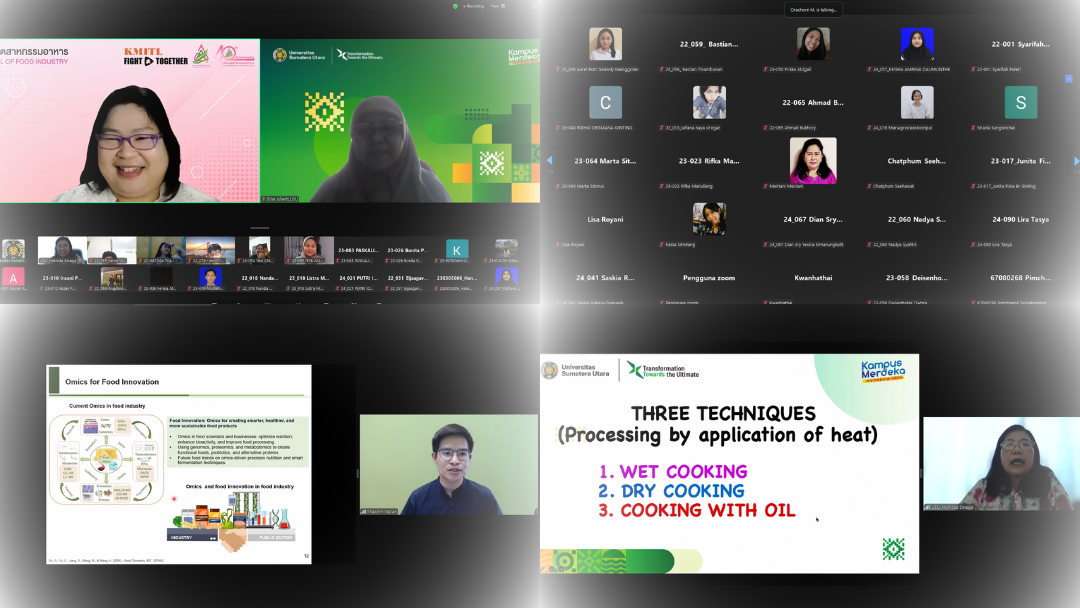
In her presentation, Prof. Hotnida explained that the world of traditional cuisine continues to evolve through various innovations and dynamic trends, while still preserving its original taste and authenticity.
"Indonesia has more than 5,300 types of traditional foods, many of which have the potential to be further developed depending on the target consumer segment. For example, dishes like tumpeng and instant spice blends are especially appealing to younger generations," Prof. Hotnida enthusiastically explained.
Currently, food technology has seen significant advancements, both in processing and quality improvement. In his session, Dr. Phakorn elaborated on the effective tools used to analyze food content and nutrition down to the molecular level.
"Omics is an approach used to comprehensively characterize and measure various biological molecules and to study how these molecules influence the structure, function, and dynamics of an organism or community of organisms. When applied to food, this approach is known as 'Foodomics'. Foodomics has become a powerful tool to identify food components and their nutritional contents at the molecular level. Today, food research continues to progress with the support of several omic branches, including proteomics, metabolomics, lipidomics, nutrigenomics, metagenomics, and transcriptomics," Dr. Phakorn explained.
Through this World Food Series Webinar, it is hoped that participants gain deeper insight into traditional Indonesian cuisine and feel more inspired to innovate further—particularly by leveraging Foodomics technology, which has already been developed in Thailand.