


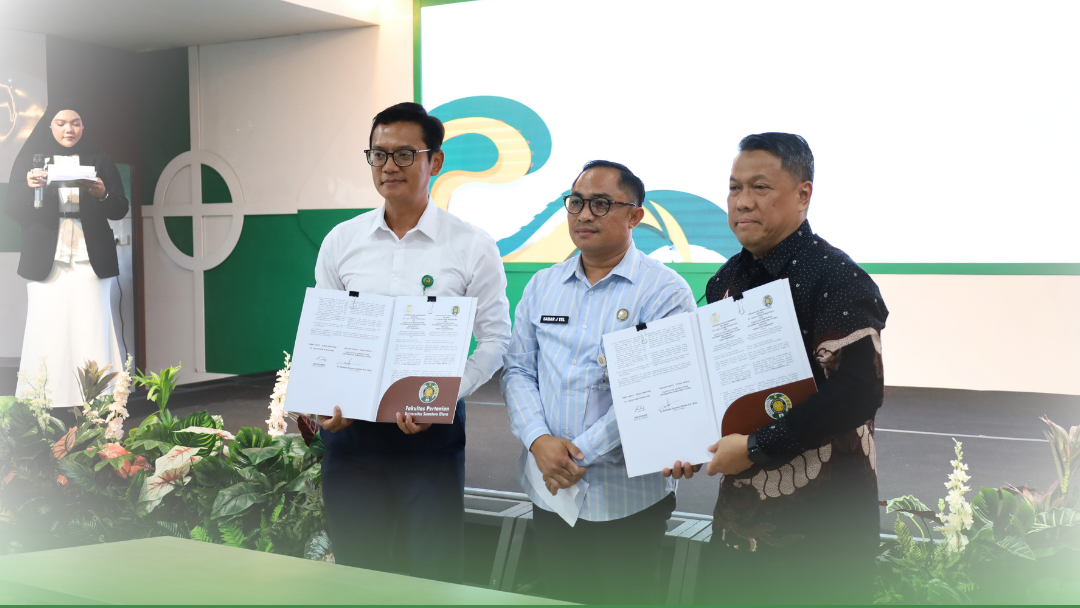
Medan, 4 August 2026 – The Faculty of Agriculture of Universitas Sumatera Utara (FP USU), together with the North Sumatra Provincial Government through the Provincial Marine and Fisheries Agency and Regal Springs Indonesia (RSI), is strengthening synergy to support the sustainability of pora-pora fish and the preservation of the Lake Toba ecosystem. This commitment was realized through the signing of a cooperation agreement during a Focus Group Discussion (FGD) entitled “Synergy and Collaboration in the Sustainable Management of Pora-Pora Fish as a Biological Resource to Support the Preservation of the Lake Toba Ecosystem,” held at Bina Graha Building, North Sumatra Provincial Government, on Tuesday (4 August 2026).
The event was attended by approximately 70 participants representing the government, higher education institutions, the private sector, research institutions, local governments in the Lake Toba area, students, and communities surrounding Lake Toba. The forum served as a joint effort to strengthen monitoring and fisheries resource management, as well as to maintain the balance of the Lake Toba ecosystem.
Chair of the organizing committee from the North Sumatra Provincial Marine and Fisheries Agency, Jenny Masniari, S.Pi., M.M., stated that the activity had two main objectives: developing follow-up measures for monitoring illegal fishing of pora-pora fish and gathering input and recommendations from stakeholders to support the sustainable management of pora-pora fish.
Dean of FP USU, Dr. Rulianda Purnomo Wibowo, S.P., M.Ec., emphasized in his remarks that Lake Toba is one of North Sumatra's greatest assets. It holds not only significant tourism value but also serves as a source of livelihood for communities dependent on fisheries, agriculture, and various economic activities.
“The sustainability of Lake Toba is not solely the responsibility of the central and regional governments; it is also our responsibility as academics,” said the Dean of FP USU.
He stressed the importance of a blue economy approach, which involves utilizing fisheries resources optimally without diminishing nature's capacity for regeneration. According to him, fisheries management is not merely about fish, but also about water, habitats, communities, and good governance.
FP USU, he continued, is committed to serving as a strategic partner in producing relevant research, developing technology, strengthening human resource capacity, empowering communities, and providing policy recommendations to the North Sumatra Provincial Government. He also expressed his appreciation for RSI's support for FP USU and expressed hope that the collaboration could serve as an example of cooperation between higher education institutions and the private sector that generates innovations with tangible benefits for society.
Meanwhile, Head of Corporate Affairs & Sustainability of Regal Springs Indonesia, Rahmat Hidayat, stated that pora-pora fish is one of North Sumatra's distinctive fisheries resources with significant social and economic value for local communities.
“This pora-pora fish is one of the fisheries resources of North Sumatra Province. It is highly distinctive, very popular, has a savory taste, and is greatly favored by the community,” Rahmat said.
According to him, the sustainability of Lake Toba is closely linked to the economic sustainability of the region. RSI and stakeholders will subsequently conduct joint studies to determine the best methods for preserving pora-pora fish, which are expected to serve as a basis for policies and field implementation.
On the occasion, Head of the North Sumatra Provincial Marine and Fisheries Agency, Sabar Jaya Telambuana, S.Pi., M.Si., emphasized the importance of strengthening monitoring in the waters of Lake Toba. Based on investigations, the decline in the pora-pora fish population has been influenced, among other factors, by fishing practices that violate regulations, the use of prohibited fishing gear, and the sale of pora-pora fishing equipment in river-mouth areas.
The North Sumatra Provincial Government, through the Marine and Fisheries Agency, has conducted field verification in seven regencies as well as routine operations to monitor illegal fishing practices in the Lake Toba area.
The event continued with the signing of a cooperation agreement between Regal Springs Indonesia, the North Sumatra Provincial Marine and Fisheries Agency, and the Faculty of Agriculture of Universitas Sumatera Utara, followed by a group photo.
The cooperation reflects the implementation of the triple helix concept, which involves collaboration among higher education institutions, the government, and the private sector. FP USU contributes through research and innovation, the government through policy and monitoring, while the private sector supports the implementation of sustainable technologies and practices.
The activity also supports SDG 14 (Life Below Water) through efforts to protect aquatic resources and ecosystems, SDG 12 (Responsible Consumption and Production) through responsible resource utilization, SDG 8 (Decent Work and Economic Growth) through supporting sustainable community economies, and SDG 17 (Partnerships for the Goals) through strengthened cross-sector partnerships.
Through this collaboration, FP USU, the government, and the private sector are committed to promoting science-based, responsible, and sustainable management of pora-pora fish to preserve Lake Toba as a source of livelihood for future generations.