


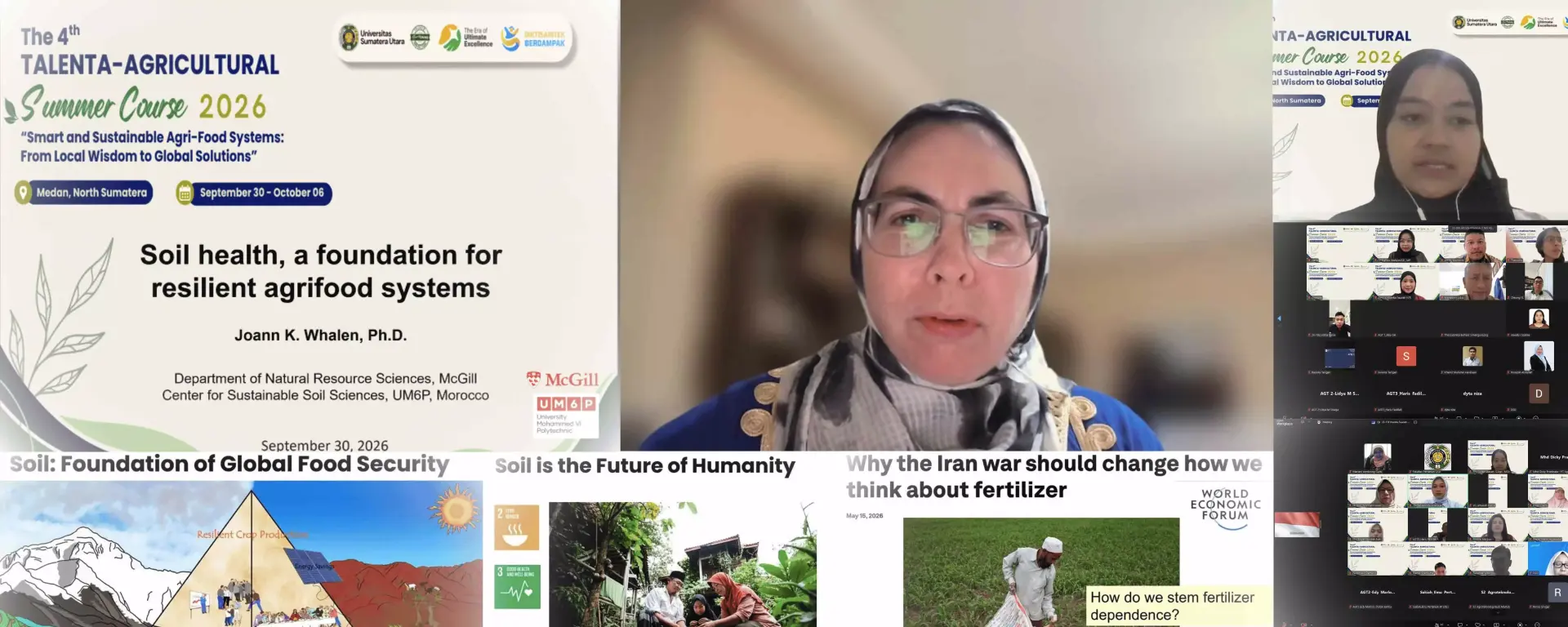
The Faculty of Agriculture, Universitas Sumatera Utara (FP USU), brought Joann Whalen, B.Sc. (Agr.), M.Sc., Ph.D., from the Department of Natural Resources Sciences, McGill University, Canada, to an International Public Lecture entitled “Soil Health: A Foundation for Resilient Agri-Food Systems” on Wednesday (September 30, 2026). The forum was part of the 4th TALENTA-Agricultural Summer Course 2026, which carries the theme “Smart and Sustainable Agri-Food Systems: From Local Wisdom to Global Solutions”. Its implementation involved the Undergraduate Program in Agrotechnology, Undergraduate Program in Agrotechnology at the North Nias Regency Campus, the Doctoral Program in Agricultural Science, and the Master's Program in Agrotechnology of FP USU.
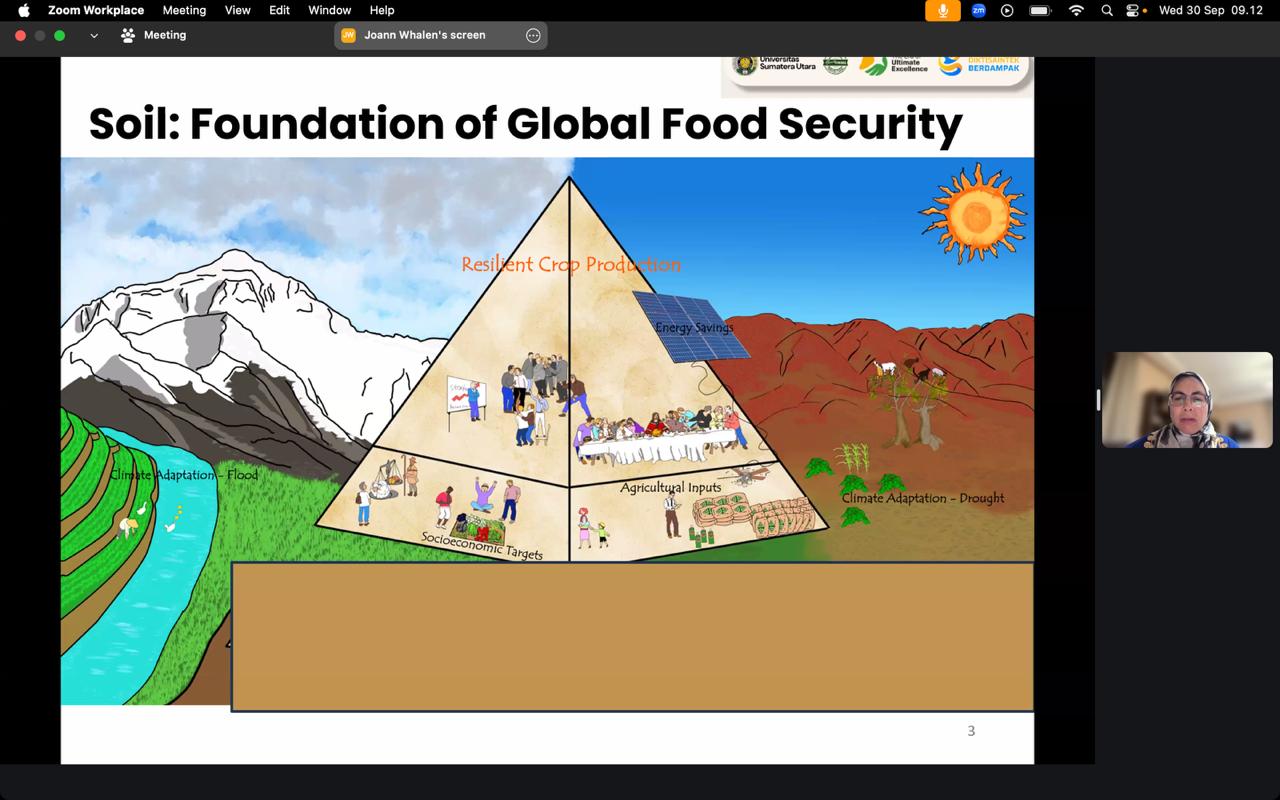
In her presentation, Joann Whalen explained soil health as an important foundation for establishing resilient agricultural and food systems. The discussion covered several challenges in maintaining soil quality, including fertilizer availability, high temperatures, salinity, and the role of microorganisms in maintaining soil functions and supporting crop resilience. This perspective positions soil not merely as a growing medium but as an ecosystem that plays a role in sustaining agricultural productivity and sustainability.
Participants were also introduced to the principles of 4R Nutrient Stewardship, namely Right Source, Right Rate, Right Time, and Right Place, as an approach to proper and responsible nutrient management. This approach emphasizes the importance of fertilization decisions that consider crop needs while ensuring efficient use of resources. This understanding is relevant to efforts to establish productive agricultural practices without neglecting the sustainability of soil and environmental functions.
The discussion session, moderated by Wida Akasah, S.Agr., M.Sc., a lecturer of the Undergraduate Program in Agrotechnology, FP USU, took place interactively with participant engagement. The presence of an academic from McGill University provided an opportunity for the academic community to broaden perspectives on soil management and agri-food systems from an international academic standpoint. The exchange of ideas also strengthened a learning space that connects local knowledge, scientific developments, and global agricultural challenges.
The discussion of soil health is closely related to SDG 2 – Zero Hunger, particularly through strengthening the foundation of sustainable food production, as well as SDG 4 – Quality Education through cross-border academic learning and knowledge exchange. Attention to soil functions and ecosystem sustainability is also in line with SDG 15 – Life on Land, while the involvement of FP USU and McGill University in an international academic forum reflects the spirit of SDG 17 – Partnerships for the Goals. Through this forum, knowledge, education, and academic partnerships were brought together to strengthen understanding of soil resource management in building more resilient and sustainable agri-food systems.