


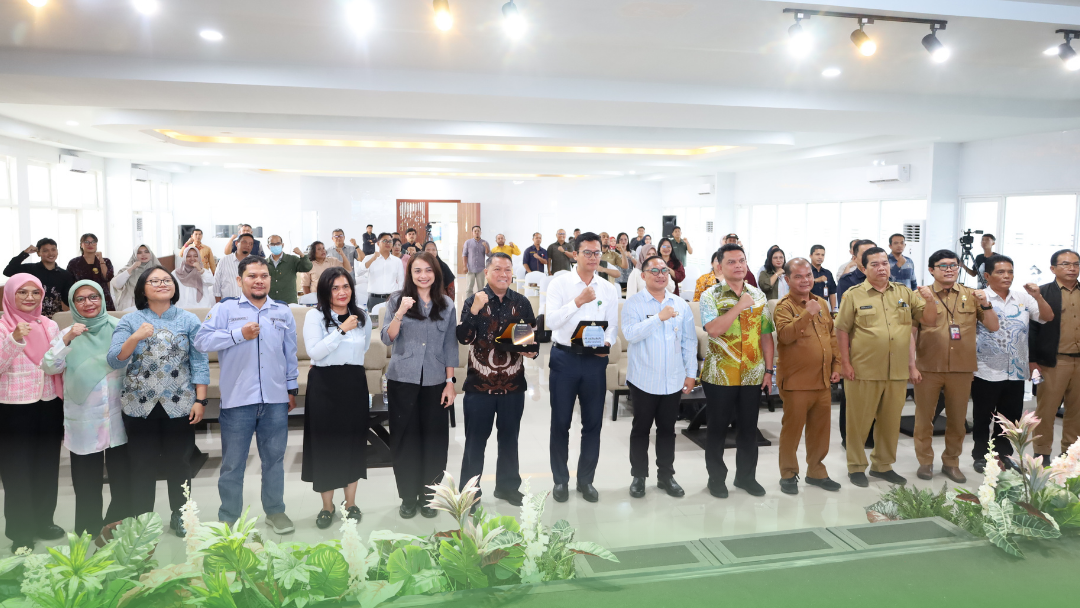
Medan, 4 August 2026 – Following the strengthened commitment through the signing of a cooperation agreement between the Faculty of Agriculture of Universitas Sumatera Utara (FP USU), the North Sumatra Provincial Government through the Marine and Fisheries Agency, and Regal Springs Indonesia (RSI), the series of activities continued with presentations and a Focus Group Discussion (FGD) on strategies for the sustainable management of pora-pora fish. Held at Bina Graha Building, North Sumatra Provincial Government, on Tuesday (4 August 2026), the activity provided a forum to explore policy, ecological, and economic aspects of efforts to preserve pora-pora fish and the Lake Toba ecosystem.
The activity was attended by approximately 70 participants representing the government, higher education institutions, the private sector, research institutions, local governments, students, and communities. The forum brought together policy and academic perspectives on the ecological, economic, and social dimensions of pora-pora fish management.
The presentation session featured two main speakers: Head of the North Sumatra Provincial Marine and Fisheries Agency, Sabar Jaya Telambuana, S.Pi., M.Si., who delivered a presentation entitled “Pora-Pora Fish Management Policies and the Role of Local Government,” and Dean of the Faculty of Agriculture of Universitas Sumatera Utara (FP USU), Dr. Rulianda Purnomo Wibowo, S.P., M.Ec., who presented “Pora-Pora Fish: From an Introduced Fish to an Economic Asset of Lake Toba.” The presentations and discussion were moderated by Vindy Rilani Manurung, S.Pi., M.P., a lecturer in the Aquatic Resources Management Study Program at FP USU.
In his presentation, Sabar Hidayat explained that pora-pora fish, also known as bilih fish (Mystacoleucus padangensis), is an important fisheries resource for local communities and therefore needs to be managed while taking into account the sustainability of its population.
One of the key concerns is catch size. Fish measuring less than approximately 10 cm should not be caught because they are still in the growth phase. At approximately 7–9 cm, bilih fish begin approaching sexual maturity, making protection necessary to allow them to reproduce.
The government also continues to strengthen monitoring of fishing practices that violate regulations. Based on investigations, the decline in the pora-pora fish population has been influenced, among other factors, by the use of fishing gear that does not comply with regulations and illegal fishing activities. The North Sumatra Marine and Fisheries Agency has conducted field verification in seven regencies as well as routine operations to monitor illegal fishing activities in the Lake Toba area.
Meanwhile, Dean of FP USU Dr. Rulianda Purnomo Wibowo presented a bioeconomic analysis approach in his presentation, “Pora-Pora Fish: From an Introduced Fish to an Economic Asset of Lake Toba.” This approach integrates ecological, economic, and sustainability aspects into fisheries resource management.
According to him, management should not focus solely on increasing catch volumes, but must also consider fish population conditions, ecosystem carrying capacity, community economic activities, and policies in an integrated manner. In this way, pora-pora fish can be utilized as an economic asset without compromising the sustainability of the Lake Toba ecosystem.
The Dean of FP USU also emphasized the importance of collaboration among higher education institutions, the government, and the private sector. FP USU contributes through research, innovation, technology, and human resource development; the government contributes through evidence-based policies and monitoring; while the private sector contributes experience, technology, and support for field implementation. This collaboration represents the implementation of the triple helix concept to generate innovations that benefit communities and preserve Lake Toba.
Following the presentations, the activity continued with an FGD moderated by Vindy Rilani Manurung, S.Pi., M.P. Participants shared their perspectives and recommendations on strengthening illegal fishing monitoring, ensuring the use of fishing gear in accordance with regulations, protecting fish that have not reached the appropriate catch size, and emphasizing the importance of scientific studies as a basis for policymaking.
The discussion also emphasized that fisheries management cannot focus solely on fish as a commodity but must consider water, habitat, communities, economic activities, and governance in an integrated manner. Pora-pora fish should be viewed as part of Lake Toba's biological wealth, possessing ecological, social, and economic value.
The results of the FGD are expected to serve as input for the development of studies and recommendations for science-based pora-pora fish management that can be implemented in the field. Collaboration among the government, academia, private sector, communities, and other stakeholders is key to achieving sustainable fisheries management in Lake Toba.
The activity supports SDG 14 (Life Below Water) through the protection of aquatic ecosystems and resources, SDG 2 (Zero Hunger) through the sustainability of fisheries-based food resources, and SDG 12 (Responsible Consumption and Production) through responsible resource utilization. Strengthening research and knowledge contributes to SDG 4 (Quality Education), sustainable community economic development supports SDG 8 (Decent Work and Economic Growth), and multi-stakeholder collaboration supports SDG 17 (Partnerships for the Goals).
Through the presentations and FGD, FP USU and its stakeholders reaffirmed their commitment to promoting science-based, collaborative, and sustainable management of pora-pora fish as part of efforts to maintain the balance of the Lake Toba ecosystem for future generations.