


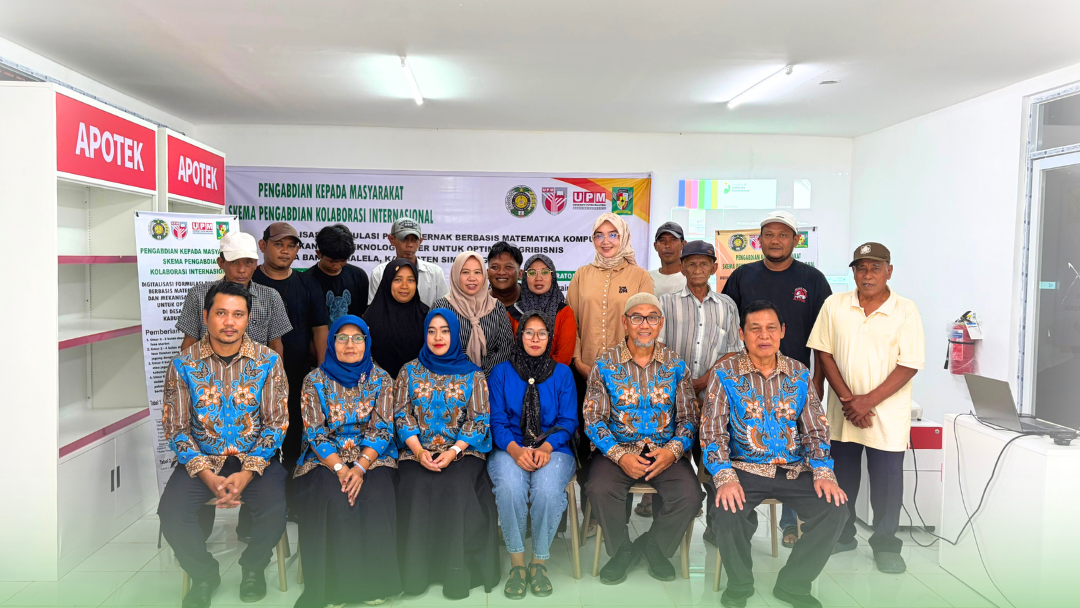
Dependence on costly commercial feed is gradually being reduced among livestock farmers in Bandar Malela Village, Gunung Maligas District, Simalungun Regency. Through a Community Service Program under the International Collaboration Scheme, a team of academics from Universitas Sumatera Utara (USU), together with academics from Universiti Putra Malaysia (UPM), has modernized the local livestock feed management system. The program is led by Prof. Dr. Tulus, Vor.Dipl.Math., M.Si., Ph.D. (Faculty of Mathematics and Natural Sciences, USU) as Team Leader, together with a team of experts comprising Dr. Amlys Syahputra Silalahi, S.E., M.Si. (Management Economics, USU); Ir. Peni Patriani, S.Pt., M.P., IPM, ASEAN Eng. (Animal Science, USU); Helova Leonard Panjaitan, S.P., M.P. (Agribusiness, USU); and Ir. Suprianto, S.T., M.T., Ph.D. (Mechanical Engineering, USU). The program was further strengthened through collaboration with international partner Assoc. Prof. Ir. Dr. Nuraini Abdul Aziz from Universiti Putra Malaysia, with Ir. Tati Vidiana Sari, S.Pt., M.P., IPM serving as a resource person.
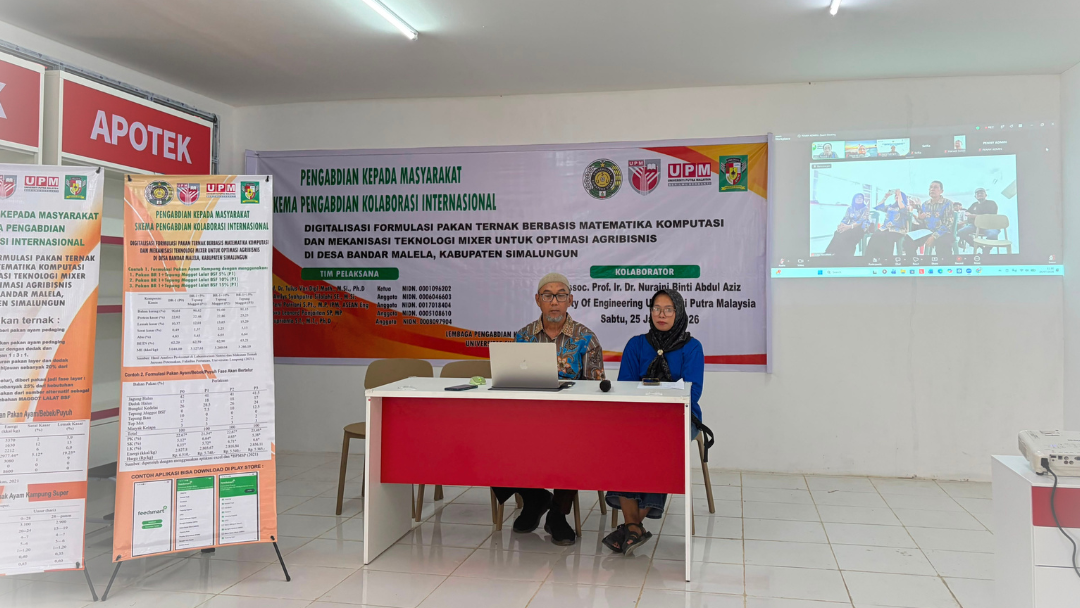
One of the main challenges faced by livestock farmers in Bandar Malela Village was that feed formulation was still carried out manually through a trial-and-error approach, while feed mixing relied solely on shovels. These conventional methods resulted in uneven nutrient distribution, leading to inconsistent livestock growth and increased expenditure on commercial feed. The community service team addressed these challenges through two key innovations: digital feed formulation using the Feed Smart application and livestock feed mixer technology. The application enables farmers to formulate feed digitally, calculate livestock feed requirements, and determine appropriate feed compositions using affordable local raw materials to reduce production costs. Meanwhile, the mixer ensures that feed ingredients are blended homogeneously and hygienically.
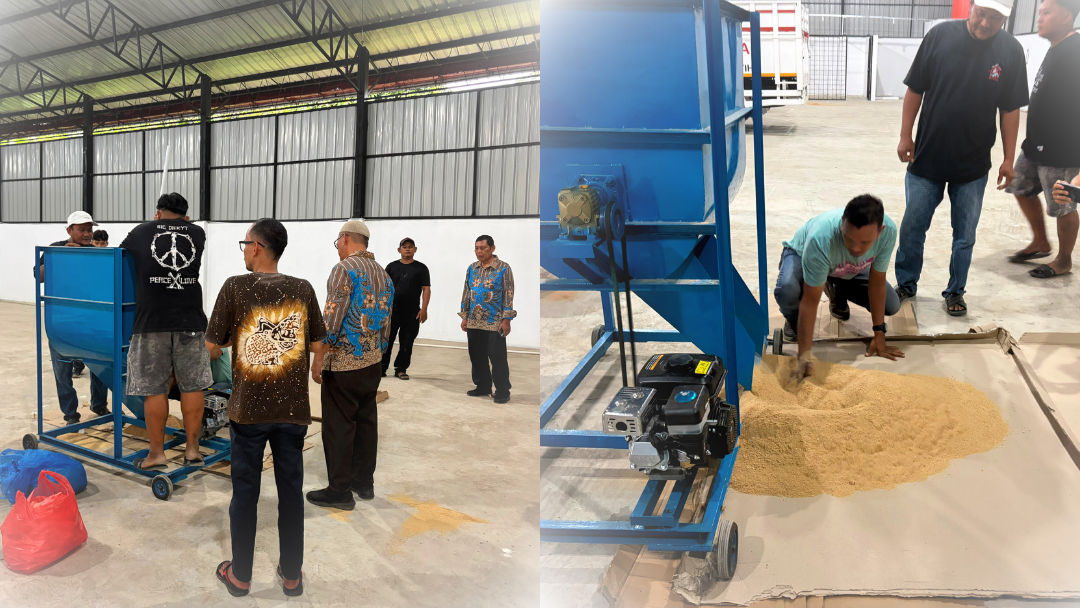
The implementation of these technologies recorded an achievement rate of 88%, with the targeted livestock farmers actively using digital feed formulation and independently operating the feed mixer. The financial benefits have also been directly experienced by the community. Farmers’ income has increased as feed costs have been reduced through the utilization of locally available raw materials. At the same time, livestock have shown faster and more uniform growth due to adequate nutritional intake.
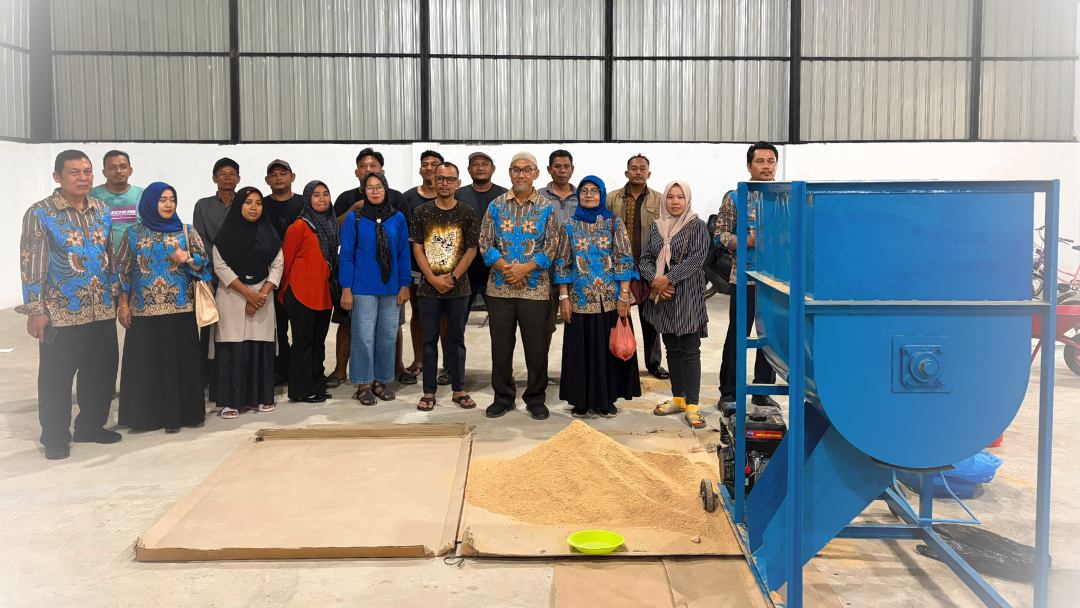
Prof. Tulus explained that the program focuses not only on technology transfer through hard skills, but also on agribusiness management assistance through soft skills, as well as the utilization of surrounding agricultural waste as livestock feed. These efforts contribute to the achievement of the Sustainable Development Goals (SDGs), particularly SDG 8: Decent Work and Economic Growth and SDG 3: Good Health and Well-Being.