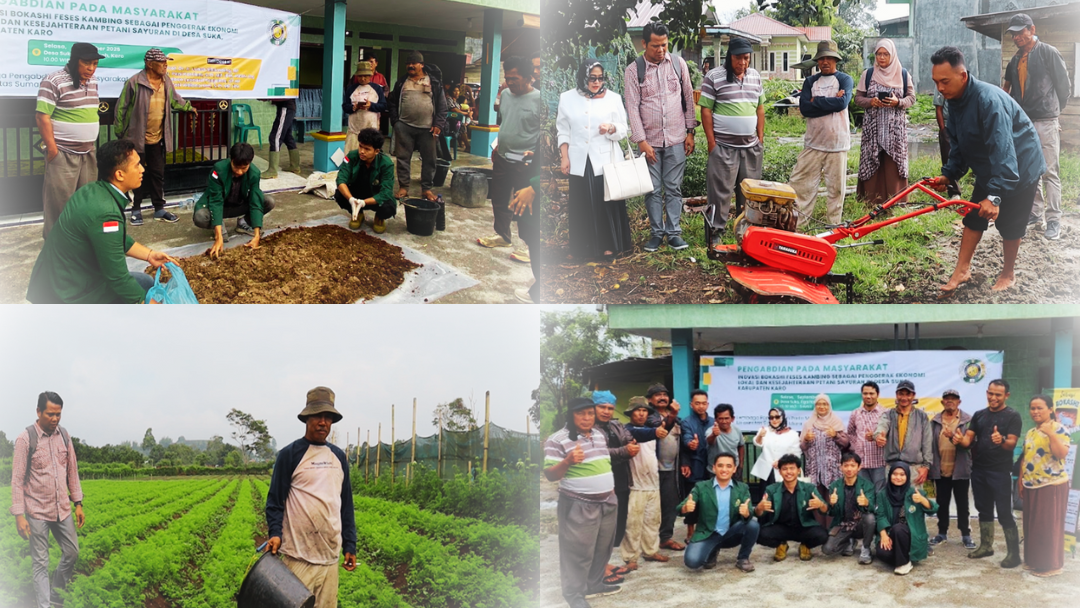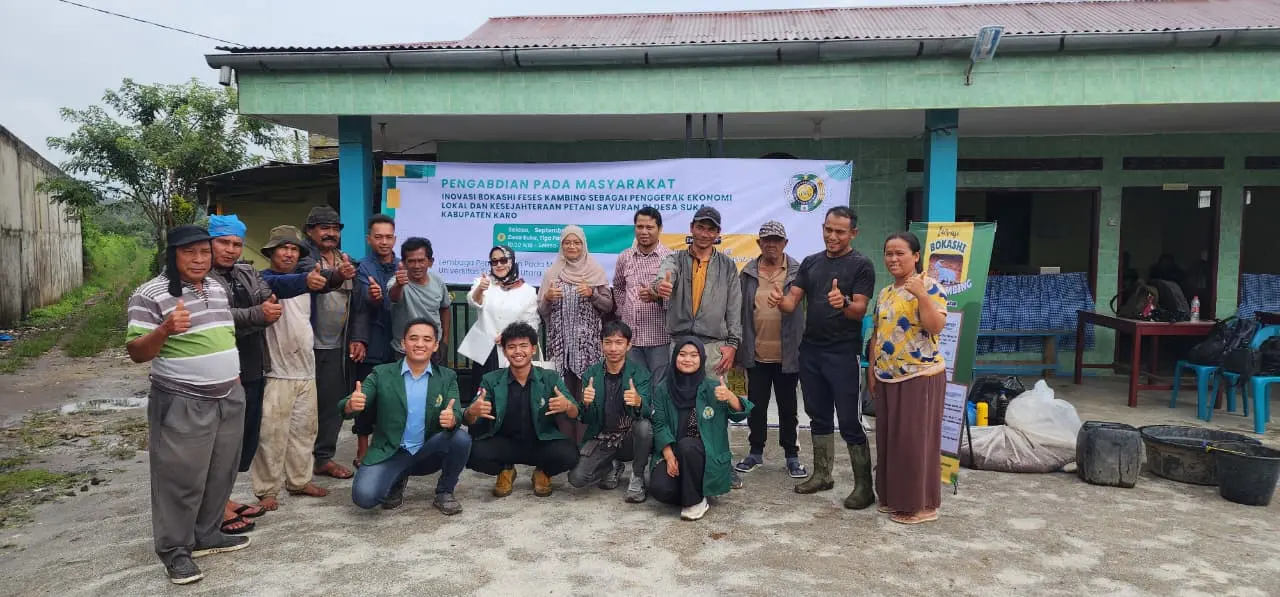
The Suka Maju Farmers Group in Desa Suka, Karo Regency, North Sumatra, is now experiencing the results of a simple yet highly impactful agricultural revolution. Through a community service program involving lecturers from the Faculty of Agriculture, Universitas Sumatera Utara—Prof. Dr. Ir. Luhut Sihombing, M.P.; Helova Leonard Panjaitan, S.P., M.P.; Ir. Peni Patriani, S.Pt., M.P., IPM, ASEAN Eng; and Ir. Tati Vidiana Sari, S.Pt., M.P., IPM—the farmers were trained to utilize goat manure, previously a source of pollution, and transform it into fermented organic fertilizer known as Bokashi. This achievement has addressed environmental problems and broken the dependence on expensive chemical fertilizers.
“Since using Bokashi fertilizer, we no longer depend on chemical fertilizers. The price of chemical fertilizers fluctuates, is expensive, and the supply is unstable,” said Alexandro Ginting, one of the farmers in Desa Suka.
The facilitator team from the Faculty of Agriculture, Universitas Sumatera Utara, then introduced Bokashi technology, a rapid composting method through fermentation. Technically, Bokashi is much faster and more efficient, allowing farmers to manage manure accumulation within days.
The program, carried out through counseling, intensive training, and mentoring, achieved a success rate of more than 85%. The majority of Suka Maju Farmers Group members successfully mastered the knowledge and technical skills to produce Bokashi independently. The positive impact was immediately felt, with around 81% of farmers now routinely collecting and processing all livestock manure. Unpleasant odors and fly disturbances in livestock areas were reported to have dramatically decreased, improving sanitation and environmental awareness among farmers. The application of Bokashi to vegetable crops such as cabbage, potatoes, and chili proved to increase crop quality, make plants more fertile, and enhance soil water retention capacity.
Economically, data showed that 89% of farmers confirmed that using Bokashi had reduced expenses for purchasing chemical fertilizers. This cost efficiency, combined with increased quality and quantity of harvests, directly correlated with increased income.
“Now we are no longer worried about fertilizer prices. We can produce it ourselves from livestock waste. This sense of economic independence is the most valuable,” said a farmer, Pleton Ginting.
The success of this program can serve as a model for other regions, as it demonstrates that utilizing livestock waste is an effective strategy for achieving environmentally conscious agricultural systems.