


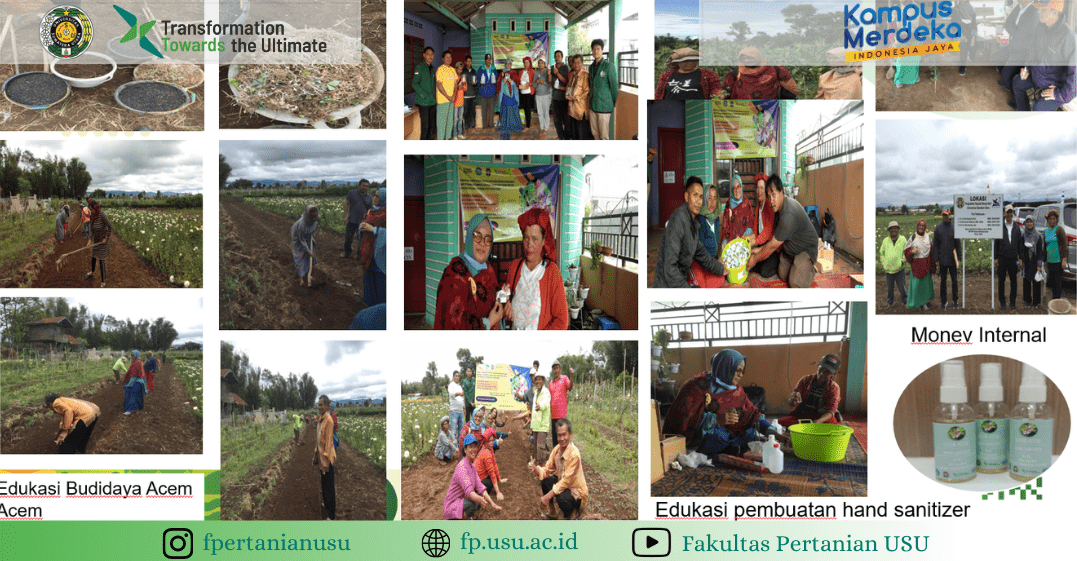
The Faculty of Agriculture, Universitas Sumatera Utara (USU), led by Dr. Ir. Yaya Hasanah, M.Si., along with team members Dr. Eka Lestari Mahyuni, S.K.M., M.Kes., and Prof. Dr. Urip Harahap, Apt., conducted a community service program in Sumber Mufakat Village, Kabanjahe District, Tanah Karo Regency.
The residents of this village are primarily horticulture farmers who cultivate tomatoes, chilies, cauliflower, broccoli, beans, eggplants, mustard greens, and cut flowers. However, intensive pesticide use in their farming practices exposes farmers to direct contact risks. To address this issue, local wisdom involving acem-acem leaves as a natural pesticide cleanser was introduced. Farmers can use these leaves by rubbing them onto their skin to reduce pesticide exposure.
Acem-acem (Oxalis dehradunensis Raizada) is a type of mountain clover commonly found in the Tanah Karo highlands. It features purple flowers, butterfly-shaped leaves, hairy stems, and fibrous roots with white tubers. The plant grows in clusters, creeping and spreading around other plants. It contains beneficial secondary metabolites such as saponins, flavonoids, polyphenols, tannins, steroids, and triterpenoids. The saponin and tannin content provides soap-like properties that effectively clean contaminants.
To further develop this potential, the USU lecturers, through a Community Service Program organized by the USU Institute for Research and Community Service (LPPM), empowered local farmers to cultivate acem-acem plants and produce hand sanitizers.
The program included training and practice sessions on acem-acem cultivation, extracting hand sanitizer, producing hand sanitizer, and transferring technology through equipment handover.
The initiative was warmly welcomed by the farmers' group (Gapoktan) in Sumber Mufakat Village. Approximately 70% of participating farmers showed great enthusiasm and expressed their willingness to cultivate acem-acem and produce hand sanitizers independently. This program successfully enhanced community understanding of the plant's benefits. Cultivating acem-acem offers a sustainable solution to ensure the availability of raw materials for health-related products.