


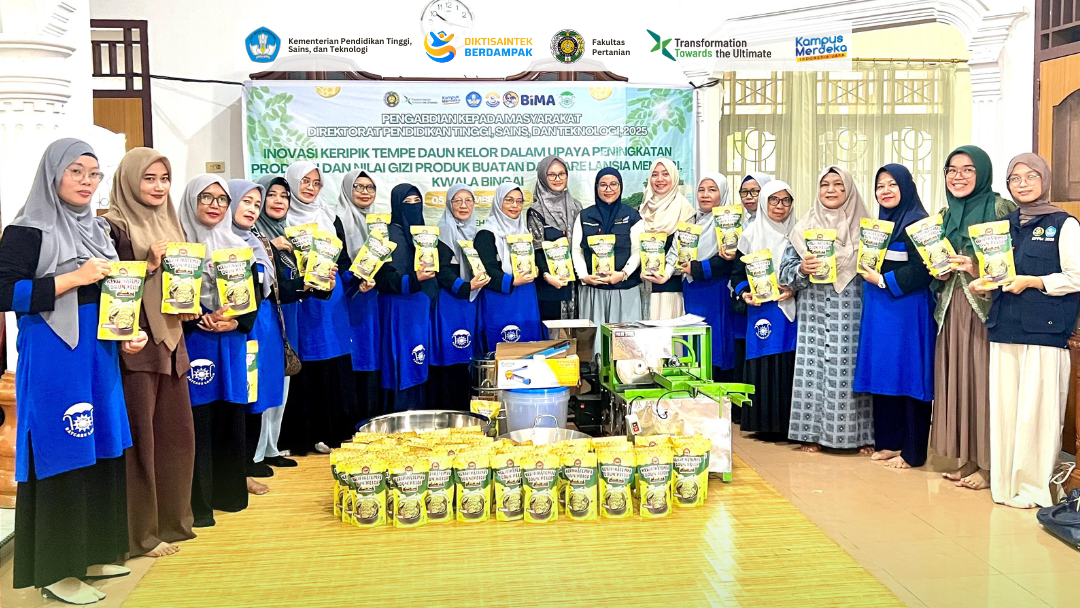
Community service activities are part of the implementation of the university’s tridharma, consistently carried out by Universitas Sumatera Utara through the support of the 2025 grant from the Directorate of Community Service and Empowerment (DPPM). This program is designed to meet the community’s need for healthy, highly nutritious, and market-competitive local food innovations. The implementation team consisted of Nur Ulina Warnisyah Br Sebayang, M.Agr. from the Agrotechnology Study Program, Faculty of Agriculture, as the team leader; with members Putri Chandra Ayu, S.T.P., M.Si. from the Agricultural and Biosystems Engineering Study Program, Faculty of Agriculture; and Ecia Meilonna Koka, S.K.M., M.Kes. from the Nutrition Science Study Program, Faculty of Public Health. The activity also involved students from the Agrotechnology Study Program, Faculty of Agriculture USU, namely Muhammad Syah Dewa and Nadira Nur Ramadhani Harahap, strengthening knowledge transfer and practical experience among lecturers, students, and the community.
The title of this community service is “Innovation of Moringa Leaf Tempe Chips to Improve Production and Nutritional Value of Products by Aisyiyah Mentari Elderly Daycare, Kwala Bingai.” The focus of the activity was directed at strengthening production capacity as well as improving the nutritional quality of tempe-based healthy snacks. Innovatively, the team introduced the use of modern agricultural machinery, including: a soybean peeler machine to speed up raw material preparation; an automatic tempe cutter to produce uniform slices; a spinner oil dryer to reduce oil content and produce crispier and healthier products; and a packaging sealer to maintain product quality and shelf life.
The use of this technology has proven to increase the work efficiency of the elderly at the Daycare, while also producing more hygienic, higher-quality, and competitive products. From a nutritional perspective, innovation was carried out by adding moringa leaf (Moringa oleifera) powder into the tempe chip dough. Moringa leaves are widely known as a superfood with high content of vitamins, minerals, plant protein, and antioxidants. This addition not only enriches the flavor but also increases the nutritional value of the product, making moringa leaf tempe chips a healthy snack alternative suitable for all age groups, including the elderly targeted by the Aisyiyah Mentari Daycare.
In addition to product innovation, the team also provided assistance on business legality aspects to ensure that the product could be officially marketed. The assistance included facilitating the issuance of a Business Identification Number (NIB), registration of a Home Industry Food Production Permit (PIRT) as a food safety guarantee, and the process of halal certification to build consumer trust. These steps were crucial so that “Mentari Moringa Leaf Tempe Chips” could not only be consumed locally but also have opportunities to enter wider regional and national markets.
The outputs of this activity showed significant results. Among the achievements were: a cinematographic video documenting the process of innovation and empowerment; a song entitled MENTARI created by the team, which has obtained Intellectual Property Rights (IPR); a trademark registration currently in process at the Directorate General of Intellectual Property (DGIP); as well as the writing of a scientific journal as an academic contribution to the development of knowledge in food technology and community empowerment.
This community service had a direct impact on the achievement of the university’s Key Performance Indicators (IKU), including: increasing student involvement in real off-campus activities, producing innovative works by lecturers and students recognized in the form of IPR or scientific publications, and creating synergy with local communities to improve welfare. Furthermore, this program aligns with the spirit of Diktisaintek Berdampak, in which science, technology, and art are presented directly to provide concrete solutions to community problems, particularly in the aspects of productive economy, nutrition, and health.
This activity also had a significant positive impact on the Faculty of Agriculture, Universitas Sumatera Utara. Through this program, the faculty not only demonstrated its role as a center for the development of science and technology in agriculture but also as a facilitator of innovation directly benefiting society. The application of modern agricultural machinery and the development of functional food products based on local resources are concrete evidence that the USU Faculty of Agriculture is capable of providing practical solutions aligned with community needs. Moreover, student involvement further strengthened experiential learning, ensuring that graduates of the Faculty of Agriculture possess practical competencies relevant to the job market and development needs. This impact also reinforced the image of the USU Faculty of Agriculture as an adaptive, innovative institution with tangible contributions in supporting the university’s vision as a center of excellence at both national and international levels.
In conclusion, the implementation team expressed their deepest gratitude to DPPM Universitas Sumatera Utara for the 2025 community service grant. This support became the main driver that enabled the comprehensive execution of activities, from planning, technology implementation, and business mentoring to the achievement of beneficial outputs. It is hoped that this program can serve as a real example of how synergy between academics, students, and the community can generate innovations that not only improve the quality of life but also strengthen the role of universities as drivers of sustainable development.