


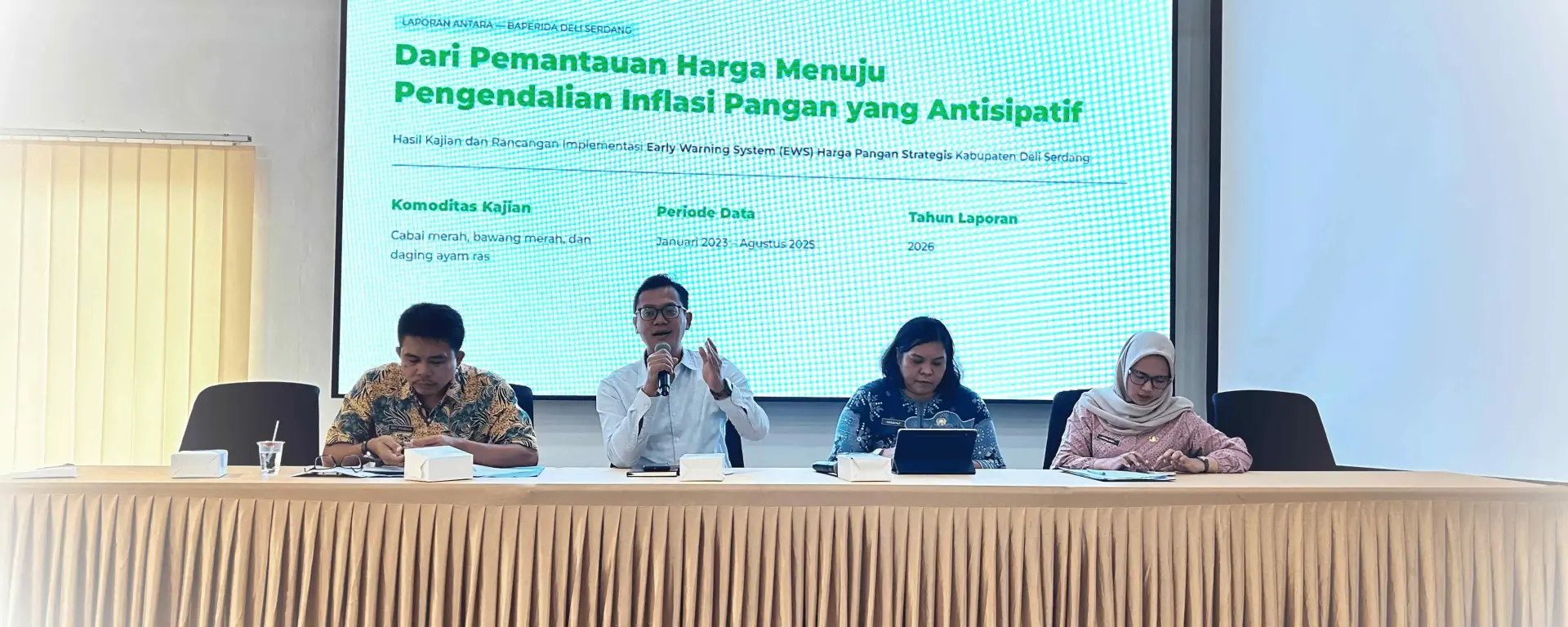
The Faculty of Agriculture, Universitas Sumatera Utara (FP USU), once again participated in the Study of a Food Inflation Control Model Based on the Production and Consumption of Strategic Food Commodities in Deli Serdang Regency, held on Friday, November 13, 2026, at the Bappedalitbang Hall of Deli Serdang Regency. This activity was a continuation of the study discussions previously held on October 14, 2026, focusing on the presentation of research findings and the implementation design of an Early Warning System (EWS) for strategic food commodity prices.
During the activity, the Dean of FP USU, Dr. Rulianda Purnomo Wibowo, S.P., M.Ec., presented material entitled “From Price Monitoring to Anticipatory Food Inflation Control: Study Findings and Implementation Design of the Early Warning System (EWS) for Strategic Food Commodity Prices in Deli Serdang Regency.” This study specifically focused on three strategic food commodities: red chili, shallots, and broiler chicken meat.
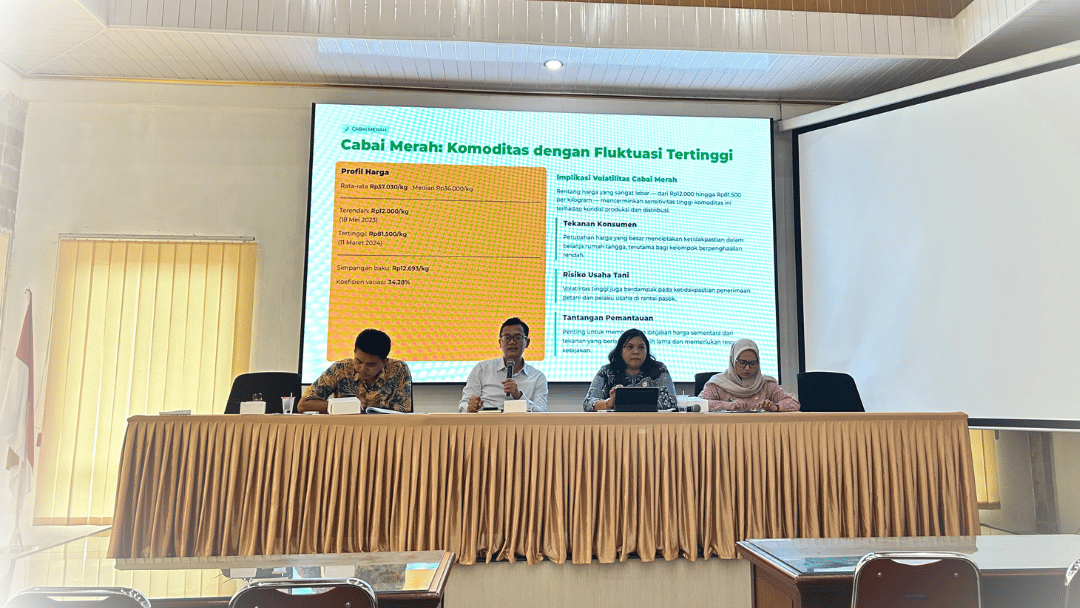
The presentation outlined four main areas of focus, including the price risk profiles of each commodity; the use of regional market price information to support price forecasting in Deli Serdang; evaluation of the Vector Autoregression (VAR) model's ability to forecast prices and measure risks over the next seven days; and the design of an EWS that integrates monitoring, verification, and coordination of responses across regional government agencies.
The development of this EWS was motivated by the importance of having price monitoring instruments capable of identifying potential price pressures before they develop into broader problems. The presentation noted that monthly inflation in Deli Serdang Regency reached 1.67% in August 2025, higher than the North Sumatra average of 1.37%. This condition indicates the need for a food inflation control approach that is more specific to the characteristics of regional markets and commodities.
Through this study, the analysis was conducted by considering historical price dynamics, regional market linkages, and various factors influencing food price formation. Several analytical methods were employed, including Granger Causality, Impulse Response Function (IRF), and Forecast Error Variance Decomposition (FEVD), accompanied by an evaluation of forecasting model accuracy. This approach aims to produce more measurable price projections and risk information to support regional government decision-making.
The proposed EWS design includes stages of data collection and validation, price movement analysis, preparation of projections along with their levels of uncertainty, as well as verification and coordination of follow-up actions. This system is expected to provide information on actual prices, regional price comparisons, price forecasts, potential risks of price increases over the next seven days, and the management status of each commodity.
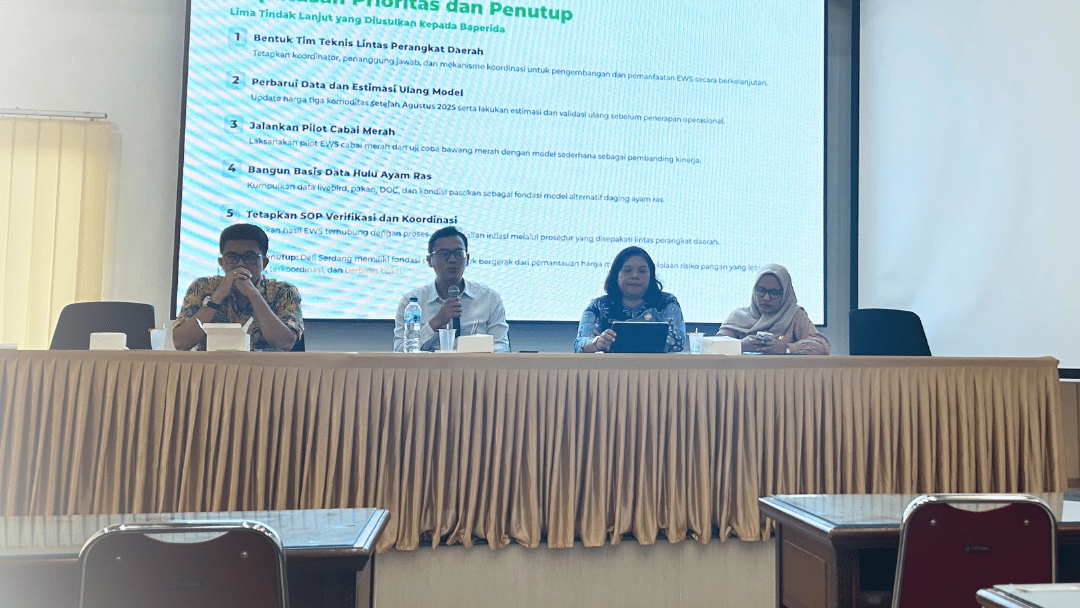
As a follow-up, the Dean of FP USU proposed five strategic steps to the Regional Research and Development Agency (Baperida) of Deli Serdang Regency: establishing a technical team across regional government agencies, updating data and re-estimating the model, conducting an EWS pilot test for red chili, strengthening the upstream-sector database for broiler chicken meat, and preparing standard operating procedures (SOPs) for verification and coordination. These steps are essential to ensuring that the study findings can be developed into practical and sustainable instruments.
Through the continuation of this study, FP USU encourages stronger synergy between higher education institutions and regional governments in developing evidence-based food inflation control policies. The EWS is expected to serve not only as a monitoring and forecasting instrument but also as a decision-support tool for responding to market dynamics more quickly, in a coordinated manner, and proactively. This initiative aligns with the achievement of SDG 2 (Zero Hunger) through strengthening food security and SDG 17 (Partnerships for the Goals) through collaboration between higher education institutions and regional governments.