


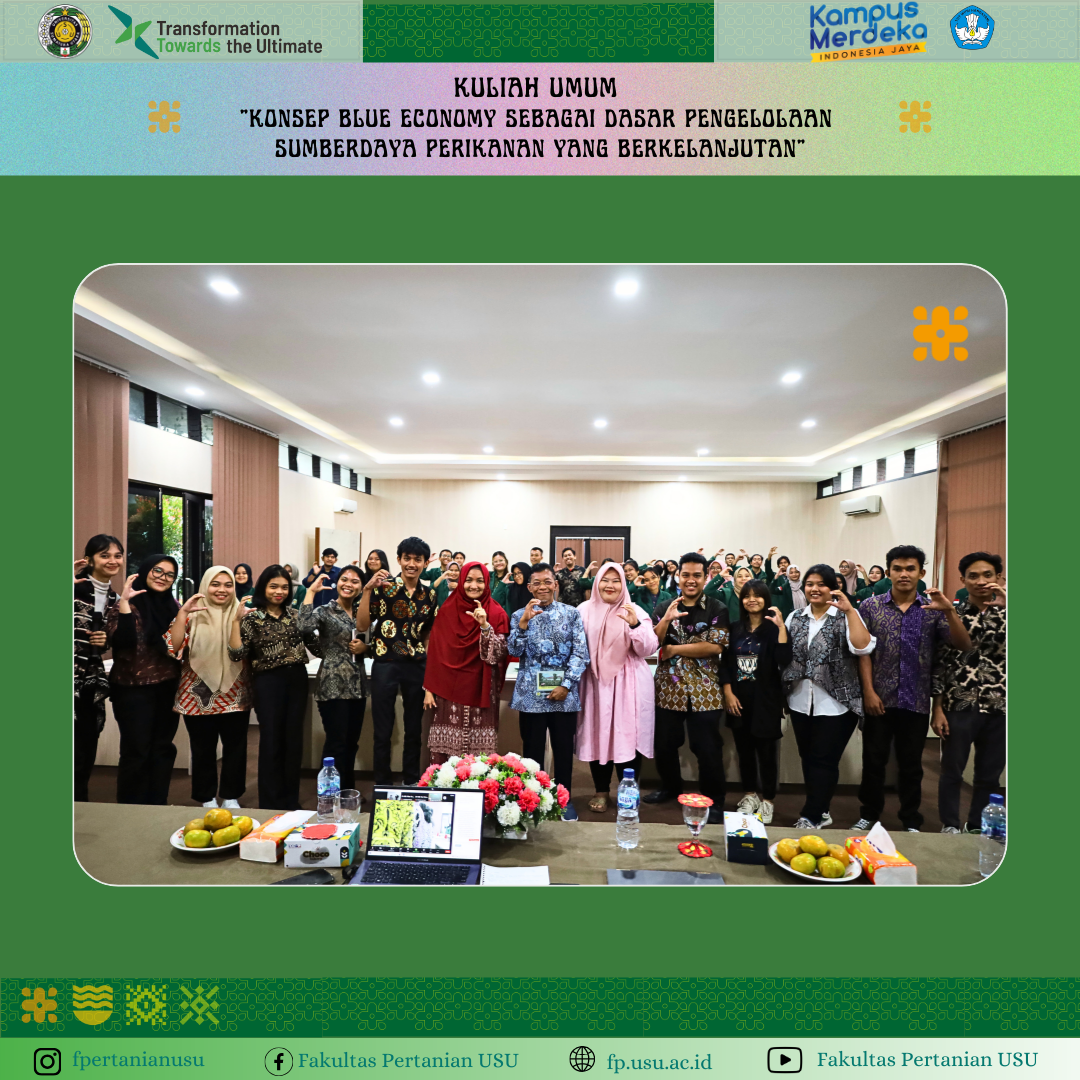
The Aquatic Resources Management Program at the Faculty of Agriculture, Universitas Sumatera Utara (USU), held a guest lecture on Monday, October 23, 2023. The speaker for this event was Prof. Dr. Ir. Fredinan Yulianda, M.Sc., a Professor of Aquatic Resources Management from IPB. The lecture was conducted in a hybrid format at the D.H. Peni Building, Faculty of Agriculture, USU, and attended by the Dean, Vice Dean 1, lecturers of the Aquatic Resources Management Program, and students.
The guest lecture carried the theme "Blue Economy Concept as the Foundation for Sustainable Fisheries Management." Prof. Fredinan Yulianda highlighted the vast potential of the Blue Economy in Indonesia, based on marine resources, which are far more abundant compared to the Green Economy or land-based resource economy. He stated that effective and sustainable marine economy management is key to developing the Blue Economy in Indonesia, especially in addressing global economic challenges.
.png)
Challenges in managing Indonesia's Blue Economy include uneven distribution of coastal and marine resource management, marine pollution such as plastic waste and industrial discharge, lack of commitment to impactful programs, limited budget allocation for the maritime sector, and sectoral ego. Additionally, low levels of education and welfare among coastal communities are significant concerns.
"Coastal communities are the backbone of the Blue Economy," remarked Prof. Fredinan.
Environmental sustainability is an inseparable component of the Blue Economy. In general, it is supported by two main pillars: the marine economy pillar and the marine environment pillar. The concept of Blue Economy is rooted in ecosystem-based economic development, integrating environmental management and economic development in a sustainable manner.
Moving forward, the Blue Economy must become a trend, so that all sectors of society recognize the high intrinsic value of marine resources. "The smallest step students can take is to study and explore aquatic resources management, and to make fish the primary food for our society. Not chicken, but fish!" joked Prof. Fredinan.
.png)
The guidelines for Blue Economy implementation in Indonesia emphasize several aspects, including prioritizing small-scale fishers, local communities, and indigenous peoples in coastal and small island areas. Additionally, transparent and advanced marine data systems, participatory end-to-end monitoring mechanisms, strict law enforcement, local wisdom-based ocean governance, expanded conservation areas, measured exploitation policies (PIT), aquaculture development, and pollution mitigation are all essential.
Ultimately, the Blue Economy is an inseparable relationship between socio-economic development for community welfare and the sustainable management of natural resources. Such sustainability must be seriously and integratively managed to create effective control mechanisms, resulting in sustainable management to support the nation's economy.
.png)