


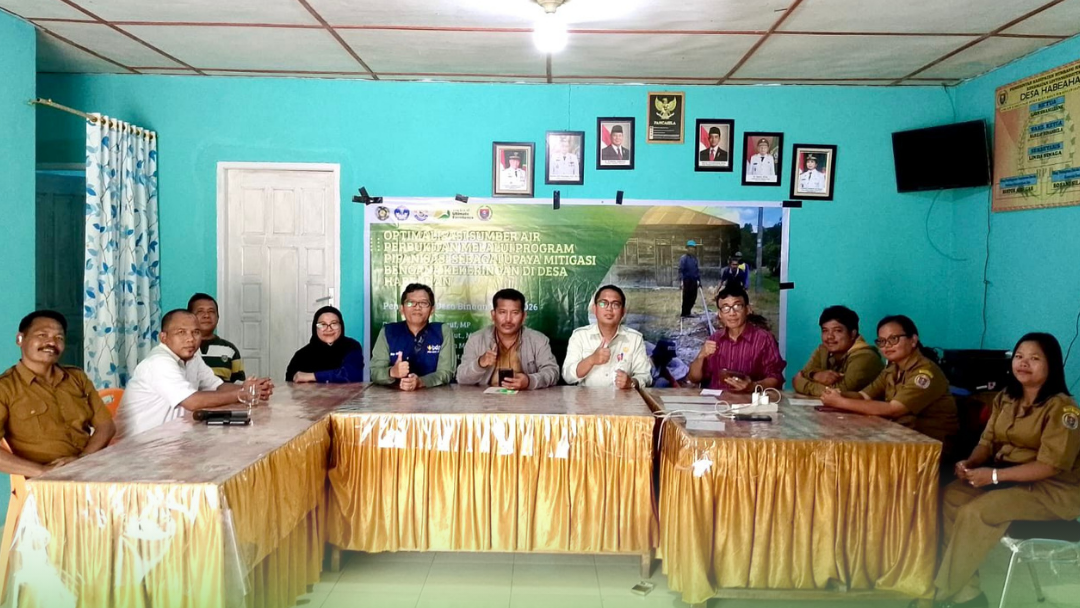
Habeahan, September 2026 — The Faculty of Agriculture, Universitas Sumatera Utara (FP USU), through its 2026 Partner Village Community Service Program, implemented a program entitled “Optimizing Hillside Water Sources through a Piped Water Network Program as a Drought Disaster Mitigation Effort in Habeahan Village.” The program was carried out in Habeahan Village, Lintong Nihuta District, Humbang Hasundutan Regency, as part of the university’s contribution to helping communities address limited access to clean water, particularly during the dry season.
The program was supported by a multidisciplinary community service team comprising Prof. Dr. Ir. Abdul Rauf, M.P., specializing in soil and water conservation and watershed management; Prof. Rahmawaty, S.Hut., M.Si., Ph.D., specializing in forestry, forest management, and land and environmental resource management; Dr. Ir. Bejo Slamet, S.Hut., M.Si., IPM., specializing in hydrology, watershed management, Geographic Information Systems, and remote sensing; Ir. Yusak Maryunianta, M.P., specializing in agribusiness, rural development, and community empowerment; Arif Nuryawan, S.Hut., M.Si., Ph.D., specializing in forest products technology; and Nur Ulina Warnisyah Br Sebayang, S.P., M.Agr., specializing in soil science, particularly soil biology and fertility. The collaboration across various fields strengthened the implementation of the program through an integrated approach, ranging from soil and water conservation, upstream area and environmental resource management, to community empowerment to maintain the sustainability of the piped water network and clean water sources in Habeahan Village.
The geographical conditions of Habeahan Village, which is located in a hilly area, mean that water sources are situated relatively far from residential areas. Although the village has potential natural water sources, their utilization has not been optimal because infrastructure is needed to channel water from the hilly areas to residents’ homes. This condition presents a challenge for the community, particularly during the dry season when the availability of clean water becomes increasingly limited.
Through the Partner Village Program, the FP USU community service team sought to optimize the hillside water source by developing a piped water network connecting the water source to the residential area. The program was designed not only to provide infrastructure but also to establish a water management system that can be maintained and utilized sustainably by the community.
The completed piped water network directly benefits 22 households in Habeahan Village. Water from the hillside area can now be channeled to residential areas, helping residents meet their daily clean water needs. The network is expected to reduce difficulties in accessing water while strengthening the village’s resilience to the threat of drought.
To support the sustainability of the program, the community service team also held a launch event and a Focus Group Discussion (FGD) on the sustainable operation of the clean water piping network. The activity provided a forum for discussion among the community service team, district government, village government, and beneficiary communities regarding the management, maintenance, and division of responsibilities for maintaining the piped water network.
The community was given an understanding that the success of the program is not determined solely by the completion of the piped water network. The sustainability of its benefits depends greatly on community involvement in protecting water sources, maintaining the network, using water wisely, and promptly addressing any damage to the piping system.
In addition to developing clean water infrastructure, the program was strengthened through environmental conservation activities involving the planting of pucuk merah (Syzygium myrtifolium) seedlings around the reservoir in Habeahan Village. The planting represents a concrete effort to increase vegetation cover, maintain land conditions, reduce the risk of erosion and surface runoff, and create a greener, more attractive, and better-maintained reservoir area.
Previously, approximately 200 sugar palm (Arenga pinnata) seedlings had also been planted, particularly in upstream areas and around springs located in the hilly area of Habeahan Village. In addition to serving as productive plants for producing palm sap and kolang-kaling (palm fruit), sugar palms play an important role in soil and water conservation. Their root systems can help bind soil, reduce erosion risks, and support the soil’s ability to absorb and retain water.
The planting of pucuk merah around the reservoir and sugar palms in upstream areas demonstrates that efforts to address drought are being undertaken through an integrated approach. The program not only channels water from its source to residential areas but also seeks to protect the environment that sustains these water resources. Thus, infrastructure development goes hand in hand with soil and water conservation.
The conservation activities received support from the Head of Lintong Nihuta District. The Head of District’s presence and involvement demonstrated the district government’s commitment to supporting greening efforts, protecting water sources, and ensuring the sustainability of the piped water program in Habeahan Village. The district government also encouraged the village government and community to care for the planted trees and protect areas surrounding the water sources and reservoir.
The Partner Village Community Service Program contributes to the achievement of several Sustainable Development Goals (SDGs). Its primary contribution is to SDG 6: Clean Water and Sanitation, through improving community access to clean water and strengthening sustainable water resource management.
The program also supports SDG 13: Climate Action, particularly by enhancing the community’s capacity to adapt to the threat of drought and changing seasonal patterns. Reforestation and protection of water-source areas also contribute to SDG 15: Life on Land, while collaboration among the university, regional government, district government, village government, and community reflects the implementation of SDG 17: Partnerships for the Goals.
By integrating piped water infrastructure development, water management education, community empowerment, and environmental conservation, the program is expected to generate sustainable benefits. Habeahan Village not only gains improved access to clean water but also develops greater awareness and capacity to protect water resources as a shared community asset.
The FP USU Community Service Team expressed its appreciation to the Institute for Community Service, Universitas Sumatera Utara (LPPM USU) for its support and facilitation in implementing the 2026 Partner Village Community Service Program.
Appreciation was also extended to the Humbang Hasundutan Regency Government, Lintong Nihuta District Government, Habeahan Village Government, and the entire community for their support, active participation, and cooperation throughout every stage of the program. The synergy among all stakeholders serves as an important foundation for realizing sustainable water resource management and strengthening Habeahan Village’s resilience in facing drought disasters.